I left a career in newspapers for a variety of reasons, among them — I was tired of telling other people’s stories. I wanted to tell MY own, and get paid doing it. Some 15 years later…my first paid, first-person piece, published by xoJane. Sometimes quickly. Sometimes slowly.
” Los Dias al Reves” — “Inside-out Days” by Pep Carrio. Part of “Think With Your Hands” exhibit at Instituto Cervantes.
I’m trying to download the app that goes with the exhibit “Think With Your Hands.” I have been unsuccessful so far.
No matter, I am taken with the art — even without the 3-D animation I can control through the app. If I can download it.
Organizer calendars, the kind kept pre-smart phone, the kind I still keep, filled with images — collage, watercolor, pencil –one for each day for a year. Then for three more. In the fifth year, a commitment to fine-line marker only. The sixth, full-color on both pages of the spread. More than 1,000 images, 1,000 days. ” Los Dias al Reves” — “Inside-out Days” by Pep Carrio.
Frames loaded with seemingly disparate objects, a wooden cut-out of a woman the only constant. Wearing a dress made of Swiss cheese. Sleeping in a horse’s belly. Swimming, torso-less. All arms, legs and head. “Los Suenos de Helena” — “Helena’s Dreams” by Isidro Ferrer.
I am marking my own commitment, my own days — Artist dates, 101 of them today. Swimming toward my own dreams — across the Atlantic, to live and to work.
No husband. No boyfriend. No booty call.
No kids. No pets.
My parents are healthy.
Not even a plant.
If not now, when?
I have been dreaming of living abroad for as long as I can remember. Only really pondering it since my divorce almost three years ago. Seriously considering it since returning from Italy in October.
And now planning it — researching TEFL (Teaching English as a Foreign Language) courses, reading blogs, Skype-ing with friends of friends living and teaching overseas and having coffee with those who once did.
Not so long ago, the only dream receiving this sort of effort and attention was love. I only knew it when it was no longer true — a few months ago, when the Reluctant Shaman came to visit.
The morning he left, we meditated in front of my altar. Then he ran his fingertips from the center of my forehead out to my cheeks — opening my third eye — wrapped his arms around me, kissed the space between my brows and said goodbye.
When he was gone, I lamented that we were only friends.
“He lives in Michigan, you live in Chicago,” I said out loud, to no one.
“His dream is to build a retreat center, yours is to live in Europe.” As the words tumbled from my mouth, I could feel the next ones forming, pushing out, birthing themselves.
“I have a dream bigger than a relationship,” I said, excitedly, repeating the phrase as if to make certain it was so.
It was so. A revelation. A victory.
One that is now being tested — less than three months after my big aha — at Instituto Cervantes, Artist Date 101.
“Los Suenos de Helena” — “Helena’s Dreams” by Isidro Ferrer. Part of “Think With Your Hands” exhibit at Instituto Cervantes.
I’m fiddling with the app when a man approaches me.
“Hello,” he says, slipping behind me so I have to turn around to face him. “How are you?”
I search my mental Rolodex, trying to locate him. How do I know this man? Clearly we’ve met. Why else would he stand so close? Act so familiar?
I tell him I am fine and inquire how he is, stalling. He grins at me.
I got nothing.
Finally I ask, “Do I know you?”
“No,” he replies. “I just wanted to meet you and thought I’d say hello.”
This never happens to me.
I laugh at the novelty of his gesture, the simple wisdom in making an introduction to an attractive stranger without premise.
We exchange names and handshakes. He asks what brings me here. I tell him I am moving to Spain.
“Where?”
“I’m not certain yet.”
We talk about Barcelona — Gaudi. The beach. Sagrada Familia. Madrid — The capital. Prado. Picasso’s Guernica. A partner program whereby I can learn Spanish part-time and receive a student visa, allowing me to work legally.
He shakes his head. How can I “just go?” Don’t I have things? Stuff? Property?
“Very little,” I offer. Whittling my life down to two suitcases shouldn’t be too hard — I hope.
He tells me he taught English in France, when he was in his 20s. I am not in my 20s. Not even close.
I smile, thank him for introducing himself, and excuse myself — returning to the exhibit.
I attempt to comprehend the Spanish spoken around me. (I get about one-sixth of it, at best.) And by the artists during their talk, taking off the headset that pipes in translation. (I get even less.) I try to download the app again. I never do.
None of it matters. Only that I “passed.” That I chose a dream bigger than a relationship. That I chose me.
A higher mark than I ever received in high school Spanish class.
Si’, es verdad.
Postscript: Less than 12 hours after my Artist Date, my path became clear. Seven days later, I put down a deposit on coursework in Madrid. I leave July 2015.
View from the “Jong Section” of Ravenswood Used Books.
Second Jewish confession regarding Artist Dates.
I have never read Fear of Flying.
Some might fret about skipping the classics — Crime and Punishment. Sons and Lovers. A Tale of Two Cities. But this is my own personal blasphemy. Isadora Wing. The Zipless Fuck.
I’ve been thinking about it a lot lately. Ever since my friend Paul asked me which living writer I admired most. I didn’t hesitate. Erica Jong.
“Good,” he said. “I want you to write Ms. Fear of Flying. I want you to introduce her to your work.”
Gulp.
I remember being introduced to her work, more than 25 years ago. I was a freshman in college. That year, Ms. magazine published a conversation between Jong and radical feminist, Andrea Dworkin.
The spread included several photographs of them sitting on stools, talking. Dworkin wearing a pair of large overalls, her hair — signature frizzy; Jong in a smart, form-fitting suit and heels. She is laughing. They both are. Dichotomies collide.
I do not remember a single word of the interview. Only these images, and that this was my first introduction to Jong, to her brand of sexual empowerment and liberal use of fuck and cunt — which, at the time, seemed shockingly like my own.
So today, when Jessica at Ravenswood Used Books asks if she can help me find anything, I do not hesitate.
Fear of Flying. Artist Date 100.
It is bright inside, which I don’t quite expect.
Jessica leads me past shelves slightly groaning under the weight and familiar musty smell of aging paper. Past the required bookshop pet, a greyhound in a zip-up vest turned animal parka, lying on a large, plaid dog bed.
All the way to the “Jong section” at the back of the store.
She climbs a ladder and pulls down a stack from the very top shelf — Fanny:Being the True History of the Adventures of Fanny Hackabout-Jones.Parachutes and Kisses. Half-Lives — an early book of poetry. Hard and soft copies of Fear of Flying.
I gather them into my arms and settle into a chair.
I remember reading How To Save Your Own Life, the follow-up to Fear of Flying, in my 20s while living in San Francisco. Picking it up at Manzanita Used Books in the Mission, where I loaded up on yellowed copies of Philip Roth novels after my once-upon-a-time boyfriend Jason turned me on to Portnoy’s Complaint.
I remember reading Seducing the Demon: Writing For My Life — which I had picked up at another used bookstore, Powell’s in Portland — more than 20 years later. Cracking its spine I felt eager to tuck into bed each night, alone, to savor a few juicy pages before passing out.
I had let go of this ritual more than 15 years ago, when my boyfriend, now ex-husband, moved into my apartment. But unlike writing — which, following a similar hiatus, returned to me a few months after our decision to part ways — reading had eluded me. Until Jong.
Her words pulled me into the bedroom in the wee hours when I otherwise did not want to be there, did not want to be poignantly reminded of the empty space on my mattress. Her words allowed me to sleep again.
I decide on Half-Lives, as it is about the point I am at — 45, middle-aged, half-a-life — along with a hard copy of Fear of Flying. I smirk.
On my way to the register, I pick up Women Who Run With the Wolves, a suggestion from my friend Pam. She said it changed her life.
I want to change my life.
I am changing it. I have been for nearly three years.
Returning to Chicago — neatly packing my messy life into cardboard boxes, living alone for the first time ever. Returning to writing. To reading. To traveling alone — to Rwanda. To Ireland, Italy, Belgium and France.
I pull Italian Days by Barbara Grizzuti Harrison and Almost French by Sarah Turnbull down from the stacks and add them to my pile — talismen. Protectors of my very recent decision to not renew my lease, but instead move overseas to teach English.
Anecdotal instructions by those who went before me of how to change my own life. Reminders, like Jong’s second novel, of how to save it.
Forgive me, it has been 16 days since my last Artist Date and 19 days since I’ve blogged.
I feel like a Jewish Catholic at confession. Except the only one I’m asking for absolution is myself.
I miss my alone time. Artistic input into my body. My head feels foggy. Squeezed. Heavy and thick. As if there is no room…no room for anything more. No room for anything at all.
I am daydreaming about when and where I can get my fix — my dose of solitude and creative sustenance.
I didn’t expect this, didn’t expect to be “hooked” when I entered into this commitment a little more than two years ago. I didn’t know what to expect. Only that I needed help.
I was newly divorced. My biological mother — who I had only met just four years earlier — was dying. And the relationship I wasn’t having — the one with a handsome southerner who lived some 900 miles away, who I kissed for two nights like a horny but innocent teenager — was effecting my relationships.
My friend S. told me in no uncertain terms she could not, would not, hear his name again.
I was on my knees, desperate. The humbled position where all change grows from.
On Christmas night 2012, a voice I’ve grown to know — my wise-self voice — suggested I work through The Artist’s Way again. Adding that this time I go on weekly Artist Dates — a once every seven-days solo sojourn to fill my creative coffers — as is suggested in the book.
I went to lectures, museums, opera. To pottery classes, dance performances, walking tours. Movies, thrift shops and book stores. All of it, alone.
On occasion, I miss a week — choosing to spend a final day with a friend before she becomes a mother or sharing my artsy outing with another — but it is rare. And I’ve never gone this long without…until now, at the Davis Theatre — Artist Date 99.
My therapist in Seattle was the first to suggest Cheryl Strayed. “I read her before Oprah,” she insisted, imploring me to pick up Wild, as well as Tiny Beautiful Things: Advice on Love and Life from Dear Sugar — the best of Strayed’s advice column from The Rumpus.
Queen Anne Books placed a special order for both books. They arrived the day after I left for Chicago.
I mostly forgot about them until this past summer — two years later — when my friend Lori insists I buy both books. She tells me “writers read,” and drags me into the Book Cellar where she puts a copy of each into my hands and guides me to the cash register.
Both are dog-eared now, and tear-stained. Sentences underlined, entire pages bracketed. Words resonate. Lessons I do not want to forget. Whispers from the universe reminding me where I came from, where I am today.
“Unique as every letter is, the point each writer reaches is the same: I want love and I’m afraid I’ll never get it.” (Tiny Beautiful Things)
“…for once it was finally enough for me to simply lie there in a restrained and chaste rapture beside a sweet, strong, sexy, smart good man who was probably never meant to be anything but my friend. For once I didn’t ache for a companion. For once the phrase a woman with a hole in her heart didn’t thunder into my head.” (Wild)
Sitting in the darkened theater, Strayed words — now images — alive before me, I say, yes. And yes.
I still fear the possibility of not finding romantic love again, but it doesn’t drive me anymore. It doesn’t dictate my every action. My every reaction.
I can be in “chaste rapture beside a sweet, strong, sexy, smart good man who was probably never meant to be anything but my friend.” Lying next to one another on my couch following morning meditation, the Reluctant Shaman’s lips pressed to my forehead — my third eye.
I no longer ache for a companion. The words, “I do not wish a man were here,” crossing my lips as I cross the Seine last October, alone on my 45th birthday..
Strayed took to the Pacific Crest Trail — alone — to learn these truths. To feel them in her bones. Mine was a different path, made of clay and dance and music. Of film and paint and spoken word. Of pasta and gelato and nearly three weeks in Italy. All of it, alone. But the truths, the same.
“So write…,” Strayed writes in Tiny Beautiful Things. “Not like a girl. Not like a boy. Write like a motherfucker.”
She’s about 4 feet, 10 inches tall, wears coral-colored lipstick — a little bit outside of the lines — and sandals with stones in between the toes. She likes pedal pushers paired with a cropped mink coat. And now 80 something, has recently taken up smoking again.
I’m not exactly sure when Sylvia came into my life. However, I distinctly remember when she came into the lives of others.
I was 25 and living in San Francisco. A single girl.
My friend Teresa was performing a one-woman show, The Life and Death of Stars, at The Marsh. And Sylvia appeared in a cameo role.
“Men are not magical beings,” Sylvia said through Teresa, taking a long drag off her Virginia Slim 120. “They’re just people. With penises. And problems.”
She appeared again when I was dating Alex, who Teresa fixed me up with. He was a foot taller than me, from my home town and said he couldn’t wait to get old because he was going to wear “Sansabelt pants up to my tits and the biggest fucking gold Chai I can find.” He seemed like a good match for Sylvia, if not for me.
He wasn’t…for either of us.
Sylvia was wise. Loving. Kind. Funny and to the point. A straight shooter.
I had not thought about Sylvia in a long time, until last Thursday — watching Birdman at the Davis Theatre — Artist Date 98.
Riggan Thomson’s (Michael Keaton’s) alter ego, reminded me of my own. Except mine is more gentle and far less destructive. And I found myself wondering what she might be whispering to me right now.
I do not even have to ask.
“Honey, go!,” she says, in a voice much louder than a whisper. “Why are we even talking about this?
She is referring to my noodling — or, as she calls it, sitting — on TEFL (Teaching English as a Foreign Language) certification and moving to Spain or Italy or Portugal, to teach.
She reminds me that I am husband-boyfriend-booty call-child-pet-plant-mortgage free. But that I might not always be. That my parents –now both in their 70s — are in good health. That they do not need me. That I have no obligations or responsibilities. And that this may not always be so.
But what about finding work as a trainer and facilitator? What about making money? Being fully self-supporting?
What about sloughing off the title of chronic under-earner? About being a responsible adult?
She brushes me off — literally waving the back of her liver-spotted hand dismissively as if I were a waiter asking if she’d like more decaf rather than her uncertain, 40-something self.
“All the time in the world for that…” she says, adding that the two are not mutually exclusive.
It seems that what I know if my head, Sylvia knows in her heart, in her bones. She’s lived it. And then some.
She knows there will always be jobs. And, God willing (She puts up her hand again, this time her palm out as if testifying. “Preach.”) there will always be Italy, Spain and Portugal. France too, she adds. But that time and ideal conditions are not similarly static truths.
She knows that security is an illusion. That the work will come. That the money will come. And yes, and even though I didn’t ask, that the man will come too.
A flood of memories rushes in. An experience with my ex-husband. A story from my childhood. Some person or situation from my past popping up in full Technicolor like a carnival whack-a-mole.
The experience of the Artist Date — a planned, solo flight of fancy with the express purpose of filling me, my creative coffers — wakes up some dormant element of my history and connects me to myself, to art, the artist and the world around me.
It is both a self-involved deep-sea diving excursion into my own unique story and the recognition of the universal experiences that knit us together in an infinity scarf of humanity.
Until today, watching Desperate Dolls, a play written by my friend’s husband, at the Strawdog Theatre — Artist Date 97.
No story. Only feeling.
Enter three girls trying to make it big in Los Angeles, the sleazy but lovable B-movie director who gives them a shot (along with campy “showbiz” names) and a creepy-powerful, sexually frustrated devil-villain called Captain.
There is a late 60s-early 70s motel room with perfect period attention to detail. And screaming. Lots of it.
I covet Matchbox’s body — flat belly and perfect ass — snugly held in white panties and a matching bra. Pretty Sexy’s Go-Go boots and thick, fluttery false eyelashes. Sunny Jack’s belt buckle and mustache.
The thoughts are random and fleeting, in no way connected to my past. Only Sunny Jack’s grainy girl films — wanna-be starlets rubbing suntan oil between their breasts to bossa nova swing; kicking ass, or more literally, kicking balls of some Snideley Whiplash of a pervert chained to a tree — evoke any sense of the familiar.
A tip of the hat to John Water’s early films. Think Mole McHenry performing a do-it-yourself sex change in Desperate Living, Babs Johnson eating dog poop in the final scene of Pink Flamingos.
It is only later that I think about my friend’s brother turning me on to these films the way my cousins turned me on to pot when I was 12, or my father returning one of them to the video rental store before I had watched it . A liquor salesman with a strong stomach and a good sense of humor, he was horrified after just 10 minutes.
In the moment I am only conscious of my stomach tightening with the uncomfortable knowing of what comes next and wishing I didn’t. Sick anticipation and the inability to turn away.
No story. Only feeling.
My sympathetic nervous system — the “fight or flight” reflex that makes my heart race and the soles of my feet sweat — fully activated.
“I love the idea of exploitation movies. Movies conceived and relying on our basest human emotions and the things that attract us to most art…” writes Anderson Lawfer, Desperate Dolls‘ Hugen Artistic Director. “This is a style that doesn’t get done on stage because of the outrageous violence and sexual situations, but why not? We all love it.”
I used to love it. I chased that sympathetic nervous system hit, rushing toward roller coasters, scary movies, and without really knowing it, crazy drama. I lost my taste for it some years ago when it became clear that real life provided more than enough opportunities to exercise my body’s stress response.
But for one night, I can embrace it — grateful for the reprieve from my mind, from my memory, and the self-inflicted, heart-pounding insanity I once craved.
I used to use the Birchwood Kitchen as my office away from my office.
It was at the center of where I often found myself when I was neither at home nor at work. For the cost of an iced tea (and sometimes not even that, as I was a “regular” and often received drinks and desserts “on the house”) I had a place where I could check my emails, do some writing, take meetings or just stop and sit in between where I was and where I was going.
Sometimes the Art Institute feels like that too. Like today — Artist Date 96.
I’m sitting in the member lounge drinking puerh ginger tea and checking Facebook on my phone. Behind me, a couple is telling the bartender their story. It appears they met online — he is from London — and they are meeting now for the first time. Perhaps not now exactly — but this day, this week, this visit. It sounds crazy and exciting. I wonder how it will all turn out. I wonder if the bartender wonders, or if she is even listening.
My ex-husband used to love to come here because it made him feel just a little bit like a big shot. Flashing his card and drinking free coffee. And hey, who doesn’t like to feel just a little bit like a big shot every once in a while.
I suppose in some small way, that is what membership is about. A reward for faithfulness and patronage. Be it a free beverage, a bag with a logo, discounts or a place to stop in between here and there. And when done well, evokes a sense of identity and belonging. “One of us.”
It whispers to my unrealized teenage dream of attending art school, which at the time, I thought was the only way to be an artist. (I was wrong.)
I am reminded of this as I make my way downstairs to the Edith Stein: Master Weaver exhibit.
The exhibit is small, and there is just one other person in the gallery viewing the work. (There are two Art Institute employees here also — one of them, in my opinion, talking too loudly.)
It doesn’t move me in quite the way I had hoped. I imagined my internal seven-year-old, the one who made potholders on a plastic loom with loopers, awakened, inspired to create. Instead, I am completely enchanted by this 90-something-year-old woman.
Trained in sculpture, she turned her attention to textiles when she was in her 60s. A video loops over and again, showing her working in the studio — clad in heavy sneakers, mixing dye in a pot on top of the stove and immersing wool yarn into it as if it was pasta.
I sit on the bench in the center of the room, watching the short film several times. It is both soothing and inspiring. I want to be like her. Still working, still passionate, respected, at the top of her game.
I want to be like her when I am in my 90s. I want to be like her now.
My neck just did that thing where it snaps back my head as it is falling forward, as I am falling asleep sitting up. It happens every time. Every time I sit in a darkened theater. It doesn’t matter if it is a movie or opera or lecture. If it is engaging or tedious. The darkness lulls me into slumber. I feel like my father before he was diagnosed with sleep apnea and was fatigued all of the time — except that I don’t snore.
I know better. I know I need to go to sleep earlier. But I am back to my old habit of sitting in front of the computer until far too late, usually doing nothing of note — trolling Facebook or shopping for something I don’t end up buying. And when I finally make it to bed, I’m left with five or six hours to rest before I do it all over again.
The habit started when I moved out of my then husband’s bedroom. I stayed up until the wee hours of the morning talking to a friend who was also going through a divorce. The late-night habit continued when I settled myself back into Chicago — although the conversations did not.
I began to consciously work on the habit. Setting alarms at 10 p.m. — alerting me it is time to step away from the computer. Getting accountable with my Weight Watchers groups — choosing “Get Seven to Eight Hours of Sleep Each Night” as the healthy habit I would work on each week. I moved from five or six to six or seven, but never quite made it up to eight.
And then I started backsliding. Call it a sleep relapse. A divorce-habit relapse. It began noticing its effects — finding myself “needing” a mid-morning tea to stay awake. Struggling to make my way out of bed, trying to negotiate my non-negotiable morning exercise. And today, dozing off during a lecture at the Art Institute, Temptation: The Demons of James Ensor — Artist Date 95.
My being here can only be described as a lazy Artist Date. I know nothing about Ensor. In fact, I’m not all that interested in or excited about the lecture. But it was highlighted in the Art Institute of Chicago Magazine and it allowed me to fulfill the commitment I had made — first, to a year of Art Dates, and when I had completed that, to 100 of them.
This public accountability prods me on — even though no one is really paying attention, other than me — even as my head dips further forward, catching only bits and pieces of the lecture.
Belgium. Seaside resort town. Alcoholic father.
Tapeworm.
Yes, tapeworm. I am suddenly awake. Awake to this pain, this presence that ate away at Ensor, that his doctors couldn’t seem to rid his body of.
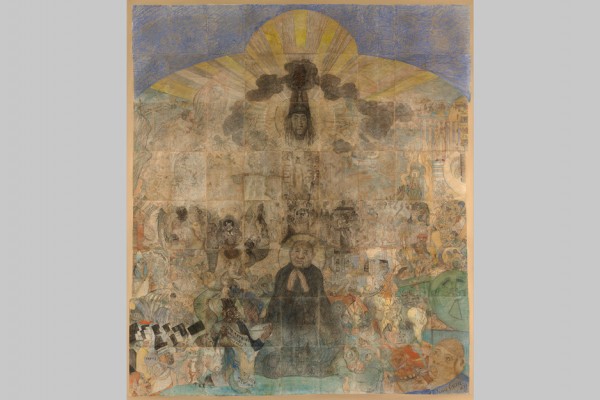
It dominates his art. Images of the worm, its feeding mouth, skeletons and death. I am struck by his commitment to it — even after it has left his body. It changed him. His story. His work.
His worm is my divorce. His drawings and paintings are my words. I feel somehow comforted by this. That it is ok that I am “still talking about this, writing about this.” That this is what we do — at least some of us. Rather than turning away from the pain, we work it out — on canvas, on paper, on screen. We allow it to change us. For ourselves to be changed.
I visit the exhibit after the lecture, wide awake. The galleries are designed so I can go in the out and out the in. There is no beginning or end. Just middle. The walls are a surprising choice of aquamarine. I stand close to The Temptation of Saint Anthony — it’s 51 pieces of pencil-colored paper layered upon each other — and look for the worm, its mouth, its suckers. I find it along with demons, a pair of red shoes and a vendor hawking frites.
On the way out, I pick up a sheet of four temporary tattoos — among them, the feeding mouth of the tapeworm from The Temptation of St. Anthony. I slip the sheet into my bag, quite certain I will not put any of the images to my skin.
I don’t need to. I have my own, permanent ones. “Write” and “Left” tattooed on the inside of each wrist in typewriter font. The tapeworm is my divorce. A reminder of what changed me and how I am changed. Of my work and how I work it out. And my commitment to it.
I wish I would have had this a few months ago…when I wasn’t willing to walk away from a man. There were all sorts of red flags. I knew he had an unkind tongue. He said things that took my breath away. Not in a good way. Things like “What’s up with the Jews?” (Knowing I am Jewish.) And “I’m not into fat chicks.” (Knowing I had been overweight…and so had he.) His communications via text and phone were erratic at best. But just like Lisa writes here, I (unconsciously) believed I needed something he had to give, and in the process I leap-frogged right over my own boundaries. It now seems terribly obvious, and somehow harshly poetic, that because I wasn’t willing to walk away, he was. And did.
However, I recently did walk away from a different situation. There was no great betrayal. No terrible harm. In fact, there was no real “there there.” I just knew in my bones I was no longer available to and for the possibility being offered. Or as my Divorce Buddy once said, “That was a limited time offer, and sadly, the offer has expired.”
Simple language. Difficult lesson. But I am learning.
Brock, a seasoned salesman, was telling me about a car he almost purchased many years ago. He was ready to sign but when the dealer wouldn’t acquiesce to the desired terms, Brock stood up and walked out. He knew that in order to be successful in any negotiation, you have to be willing to walk away.
As he finished his story, I thought about the times in my life when I was willing to walk away:
The first (and second and third) dates with men I was curious about but not invested in.
The job interviews and possibilities when I already had something paying the bills.
A blog submission to an outside site when they had already picked up at least one post.
The books from the library or the free movies on TV that failed to maintain my interest.
In every case, I was more relaxed and curious than anxious…
A month has passed since I returned home from my solo sojourn to Italy. It feels like forever ago.
Life comes on — quickly, strong, demanding — and I struggle to hold on to the peace and freedom I felt abroad. The joy in getting lost, not knowing the answer — or sometimes even the question, in being alone. My face looks pinched — the wrinkle between my eyebrows, smoothed by Umbria, has returned.
The decisions I made, the desires of my heart — to live overseas, to publish a book (or more to the point, to be published) — begin to slip into the category of “all talk.”
I recently read that most people would prefer to fail by not trying than fail by trying. I get it. I understand. I wish I didn’t.
And so I find myself at Pizzeria Sera on a Tuesday night listening to six women tell stories about how and where and when they found confidence — hoping to be inspired, or at the very least, to borrow some — Artist Date 94. The monthly event, called About Women, is the brainchild of my friend Nikki Nigl. A force of confidence, not to mention nature, in her own right.
The mere decision to be here bolstered mine some, helping move me forward in the hours before arriving.
Sitting at the computer, doing nothing but waiting for something to happen, I mutter, “Do something. Anything.”
I write an email and send it off. (Two somethings. Write — one. Send — two.) A few lines to the sister of a friend of a friend who just returned from Spain, where she taught English for several years. I ask if she might meet me for coffee and share her experiences — how she got there, what it was like.
I tell myself it is something. It is enough and move on with my day — meeting with my rabbi a final time before he leaves our congregation. We talk about his departure, my desires, and deciphering the will and whim of the universe. Especially when it seems to only speak in whispers.
It feels like a game of telephone and I constantly wonder if I’m hearing it right.
Until I get to the parking lot, into my car and check Facebook.
“Anyone want a job in Portugal NOW?”
The post describes an academic coach position at a school outside of Lisbon. Scrolling down, I am tagged. “Lesley Pearl, could it be you?”
My heart swells, leaps. Not because I believe I will get the job and move to Portugal (although I might), but because the universe seems to be speaking loudly, clearly — the message undeniable,”Yes, Lesley, it is possible.”
Settled at home, I write a response. It begins, “Yes.” (Three somethings.) Shortly thereafter, I am Skype-ing with a teacher at the school in Portugal, the one who extended the possibility, dangled the carrot — gathering more information. (Four.)
Turns out I’m right on course, so say an advertising executive, a scientist, a minister, a mud wrestler, a mother and a writer — this month’s About Women storytellers. While the details differ, at the core of each woman’s parable is fear — and the decision to do “it” anyway. Ask for a raise. Leave a job. Leave a husband. Take an improv class. Ride a roller-coaster. Pet a dog. Live as an outsider.
Each took action when the pain of inaction became too great. Was no longer an option. Or when “the worst that could happen” seemed less scary than living with “what if” and “I coulda.” And their confidence blossomed.
“Stop focusing on the heart-pounding, vomit-inducing, brick-shitting aspect of everything and start focusing on the payoff,” Kira Elliot — a personal trainer, mud wrestler and Mary Kay Sales Director — says from the stage. “Pretend until the point of no return…then reap the rewards.”
Amen.
Post Script. Three days after the event, I send a resume and cover letter to the school in Lisbon. I am amazed to see the resistance in myself. Fear masquerading as logic and practicality. It feels “heart-pounding, vomit-inducing and brick-shitting.” I fazê-lo de qualquer maneira. (That’s Portuguese for “I do it anyway.”)





 A Wandering Jewess