Artist Date 38: Creating Community…It’s Not About the Shoes

I don’t know if I filled my creative coffers this week.  By my spiritual and social ones are brimming over.  And that will have to do this week for Artist Date 38.

Overlooking Lake Michigan, at Dawes Park.

Rosh Hashanah – the Jewish New Year. 5774.  I’m at Dawes Park in Evanston for the ritual of tashlich – where we empty bread from our pockets into a body of moving water.  Some think of it as casting away one’s sins.  I prefer a gentler interpretation.  That I am simply cleaning out the residue of the last year.  Whatever is stale.  Has been sitting around in the corners of my consciousness slowly growing a somewhat furry mold.

I’ve stuffed a package of naan bread in my bag.  It’s been in my freezer since November.  A friend brought it to a party I had, to go with the curried lentil soup I was making.  I’m not much of a bread eater, so I tucked it away for just such an occasion.

Another woman has matzo.  I could have brought that two.  I buy too much every year.

It is my third High Holiday season with the Jewish Reconstructionist Congregation, so I know where we meet.  But this year is different.  I not only know the place, but I know many of the people here too.

My friend Phil is here with his family.  He introduced me to this congregation – specifically the Rabbi — a number of years ago, when I was feeling particularly wayward and spiritually lost.

Since that time I have developed a close relationship with Rabbi Brant and Cantor Howard.   They are tuning up for this short, mostly musical, service that precedes the tossing of the bread.  Jeff is tuning up as well.  We met a couple of years ago at a Shabbat morning service I attended just once.

He seemed to sense I was new and somewhat hesitant, and warmly welcomed me in.  I have had several encounters with him since them.  Perhaps my favorite being when he sidled up to me during last year’s High Holiday services.

He said he read my blog postings from Rwanda and that he liked my writing.  I thanked him and told him I used to write professionally.  “It shows,” he said.  And was gone.

Moments before I had silently cried out to G-d, asking what the plan is, what it is I was meant to do.  I recall looking up toward the heavens, smiling and saying, “got it.”

Mary Jo is here.  Brant introduced us several years ago when I completed my conversion to Judaism.  She joined him and Howard as my witnesses, and was there in that same role when I received my get, my Jewish divorce.

I am now on her permanent invite list for Passover, and the breaking of the fast on Yom Kippur.

I feel a tap on my shoulder.  It is Rachel.  She is a Weight Watchers member I know.

Monica is here with her family.  We met at Shabbat services at the lakefront a couple of years ago.  Michael is here too.  He blows the shofar every year at High Holiday services.  He introduces me to his daughters who are following in the family tradition.

I see Hannah.  She used to wear her head shaved like mine but now she has a mass of ringlets.  She tells me that she’s bought a condo and that she broke up with her boyfriend.  She introduces me to her friend Kelly and we agree we must get together.

A woman I have never met before approaches me.  Her name is Sheila.  She likes my shoes and takes a photograph of them.

Yes, they are “the shoes.”  The shoes that have seemingly come to identify me.  My orange Fly London peep-toe wedges.
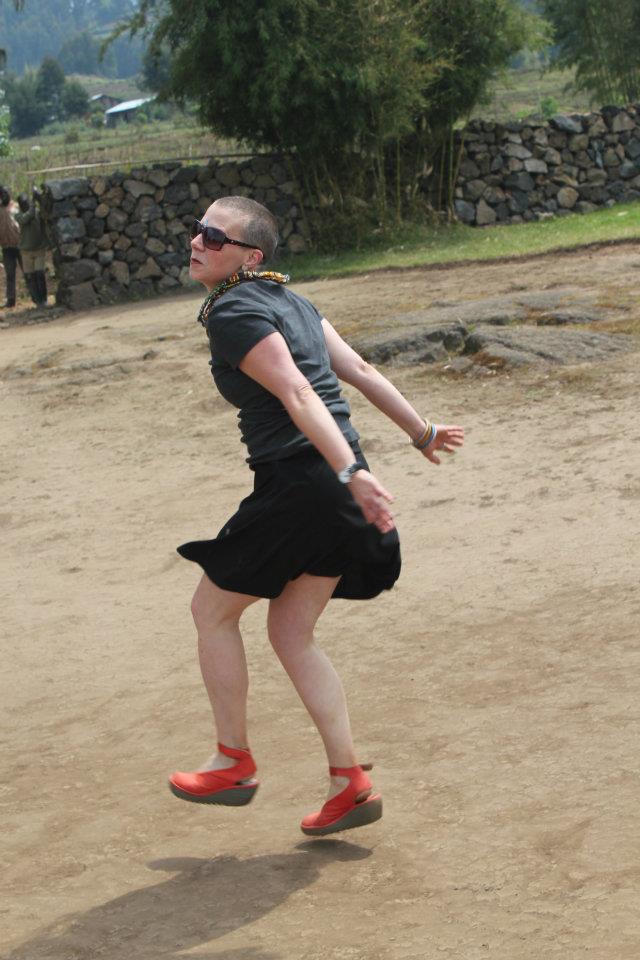
The shoes...
The shoes…

The first summer I owned them, people literally chased me down Michigan Avenue to find out what they were and where I got them.  It was fun, talking with all sorts of people I wouldn’t otherwise meet.  And today is no exception.

Walking to the water, a tall woman with a mess of dark curls puts her foot next to mine.  “Nice shoes,” she says.  She is wearing the same ones in pewter.

She tells me she is tossing out the year of rehabbing her broken wrist.  It is healed.  I do not tell her what I am tossing.  Instead, I tell her I like our shoes so much that I have two pairs.  That the second I bought before my divorce was final, when my then-husband kindly said, “Do what you need to before we separate our monies.”

I bought a new lightweight massage table, a Torah commentary, and the peep-toe wedges in mustard.  We laugh at my choices.

I wish her a sweet New Year and peel off to throw my bread, my karmic residue.  There are so many things I could get rid of.  The litany that I repeat every year – self-doubt, unkindness, judgment of myself and others.  I recall that last year I tossed away my identity as a wife.

It was a Monday.  I knew divorce papers were signed on Mondays in the county where we filed.  I had a sinking feeling at that moment that I was officially divorced.  A call to my mediator later in the day confirmed it.

Today I am casting away what my friend Lisa likes to call “an old idea.”  I am embarrassed to admit that I have continued to hold on to it.  Actually, I’m not sure I was consciously aware that I had it, but a series of recent events has cast a glaring light upon it and I can no longer turn away.

I point myself east, tear off a piece of naan and whisper to myself, “I let go of the idea that I am only desirable for sex.”

It is windy and the naan flies back at me.  I turn west off of the dock where the waters are still.  I repeat the words.

I’ve got a lot of naan so I say it a couple of more times, ripping and tossing.  Ripping and tossing.

When I am done, I am approached by a woman.  She asks me about the shoes.  She is radiant and I tell her so.  She tells me about her job search.  Her cancer.

I suddenly remember that people used to tell me things about themselves all of the time.  Friends and family, and random, almost strangers too.  Cab drivers especially.  I realize people are talking to me in this way again.

It’s not the shoes.  Because I wore the same ones last year…I am different.  My heart has healed just enough to let some of my light shine out.  I am open and there is room for others.  They sense it and come in.

Artist Date 36: The Happy Show

2013-08-22 17.12.37I am chewing on a piece of ginger candy and drawing a daisy – poorly – on a square of yellow paper, giggling to myself.  The enormous blow-up animal in the other room, the one with its ass cocked north, is dancing around in my head.  I am happy.  Not just in a general way.  But in this very-present, animal-ass-in-the-air, right-now moment.

I give it an 8.

2013-08-22 17.06.05I’m on the fourth floor of the Chicago Cultural Center, at The Happy Show – Artist Date 36.  Two people mentioned it to me within two days of one another.  I take it as a sign.

Walking in, I am asked to rate my happiness and to take a gumball from the large, plastic tube with its corresponding number.  I say 7.  Popular number.  This is the least filled cylinder, followed by 10.

2013-08-22 15.57.37Ten.  No greater happiness.  Unless it goes up to 11 in a This Is Spinal Tap sort of logic.  I have been at 10…in moments.  And I think that’s sort of the point – recognizing pure-bliss, happy, 10 moments when they happen.  And thanking your lucky stars.

Noticing the runny yellow and crisp white of a fried egg.  The chills up your spine every time you ride a scooter on a beautiful, windy road.  No helmet.  Listening to music you love, but don’t know well enough to have stories associated with it.  These are Stefan Sagmeister’s – the show’s creator – happy moments.

Mine is on my bike.  A vintage, Raleigh three-speed with a basket and a bell.  Except I wear a helmet.  And I don’t listen to music.  I sing.  Usually Rosemary Clooney’s “Do You Miss New York,” or Talking Heads’ “Road to Nowhere.”

“There’s a city in my mind, come along and take that ride and it’s all right.  Baby, it’s all right.”

Sagmeister designed album covers for Talking Heads, as well as my hero, Lou Reed.  I wonder if he designed Little Creatures, the album this song is from.

I am photographing every inch of the exhibit – Sagmeister’s 10-year exploration of happiness – literally.  The language is so spot-on.  I don’t want to forget a single word – all of it printed on yellow walls, in fonts that look like handwriting.  Some words are cleverly crossed out.  Perfectly imperfect.

Rules to live by, culled from Sagmeister’s diary, manifested in print, sculpture, video, and dance.

“Uselessness is gorgeous.”

Thousands of cigarette papers are taped to the wall with fans blowing on them.  I step away from them to see the words embedded in the paper.  It is gorgeous.  I think about my friend Pam noting that I wear a $2 shirt from the Salvation Army with $85 underwear.

Not quite –$35 is my max.

2013-08-22 16.18.54“Make the first step.”

I watch a video of a group of Balinese girls performing a dance, unrolling strips of yellow fabric, displaying these words.  Sagmeister recalls his mother approaching people, rather than waiting to be approached.

“I do this,” I think.  Almost always.

“Over time I get used to everything and start taking it for granted.”  Sagmeister writes the words with his finger – in the dirt on a car, in soapy suds on a man’s hairy chest.  With playing cards and with hotdogs.

Yep.  It’s true.  And, Sagmeister explains, even the words “I love you,” said by the same person, become boring.  I think about my ex-husband.  In the year since our divorce, he has often told me that he misses our life together.  And that I look really good.

I want to tell him he should have thought about that before he opted out, but I don’t.  I know there are reasons our marriage stopped working.  Among them, I am certain, that somewhere along the line we took one another, and our life together, for granted.

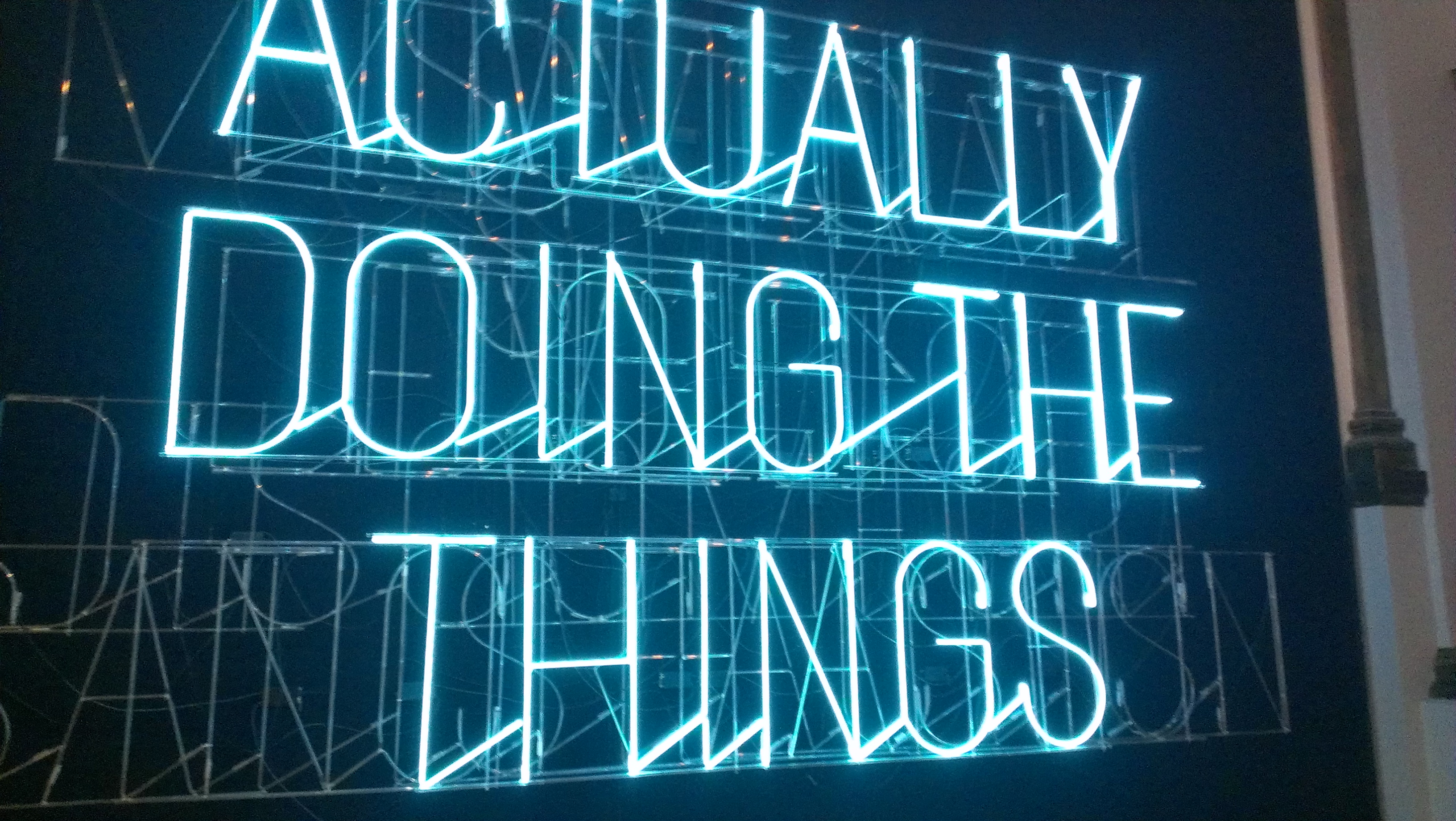
“Actually Doing the Things I Set Out to Do Increases My Overall Level of Satisfaction.” Agreed.

2013-08-22 16.55.16“Everybody Always Thinks They Are Right.”  ‘Nuff said.

“Drugs Are Fun in the Beginning But Become a Drag Later On.”  Ditto.

On my way out, I am asked to draw my symbol of happiness on a square of yellow paper.  No smiley faces allowed.  It is the second time I am asked to do this – the first time, on the way in, I draw a heart on one side, two stick figures holding hands on the other.  This time I draw a daisy.  I don’t know why.  It just makes me smile.  Like the flowers I buy for myself most every week at Trader Joes.

Hans – my favorite, morning check-out guy – once gave me sunflowers.  Pulling them from my basket, he asked if the blooms were for me.  When I told him that they were, he responded, “They are on me.  And pick up a second bunch on the way out.”  I think it made us both happy.

I walk through the exit, which has been made into art.  The words, “every” precede “exit,” and “is also an entrance” follow it.  As instructed, I push a button and take the card which shoots out.  It reads, “Find a reflection of yourself and tell it what you really think.”

On the way out, I stop in the bathroom.  I look in the mirror and whisper to myself, “You are lovely.”  My lips curl into a big smile.  And I am.

……………………………………………………………………………………………………………………..

And you?  What do you say to your own reflection?

Artist Date 35: Disgusting, Filthy, Transcendent, Delicious Neruda

nerudaThe other day my friend Gene asked what poetry I was reading.   I wasn’t.  I wasn’t reading anything at all.  Nothing since the juicy Anne Sexton biography, the one that served as an introduction for us.

I asked him to make a suggestion.  He didn’t hesitate.

Pablo Neruda.

“Disgusting, filthy, transcendent, delicious.”  His words not mine.  I was immediately hooked.

A few days later, I am at the Harold Washington Public Library, looking for Neruda – Artist Date 35.

I saw this place for the first time just a few months ago, on the way to a party in the South Loop.   Driving down State Street, I asked my friend Liz what the building was with the great green gargoyles on top.  She told me it was the library.  I made a mental note and kept driving.

The gargoyles are calling me as I approach it.  I feel giddy and excited to be here, in this place I’ve never been before.

Disgusting, filthy, transcendent, delicious.  Seemingly homeless men are sitting on the low wall outside of the library.  I take a photograph of the El train sign and am hit by the stench of sewer.  I suddenly realize this is the Library stop.  The only time I pass it is on my way to Midway airport, when I have to travel the whole of the Loop before heading south.  I feel silly.  Like I should have known.

2013-08-15 15.36.13I walk in a side door and follow the marble hallway to the main entrance.  I have never been in a library this grand.  The one at Michigan State University may have been larger, but it looked like post-Cold War “throw-up architecture.”  Like the kind I saw in Dresden.  Utilitarian.

I don’t recall visiting “the main library” in any city.  I have tended toward community branches in Oakland, Seattle, the suburbs of Detroit, and here in Chicago.  I am shocked and a little horrified.  In fact, I don’t want to admit it here.

I think of George Peppard slipping his book into the stacks at the New York Public Library, Audrey Hepburn at his side.  Genius.

Kids are playing ping-pong in the room to my left – some sort of summer program.  Ping-pong.  It feels almost quaint.

I climb the stairs to the third floor – circulation.  I look up Neruda on the research computer that has replaced the card catalog.  Seventh floor.  On my way up, I read the quotes painted on to the walls.

“My Alma Mater is the Chicago Public Library,” David Mamet.  “Wisdom begins in wonder,” Socrates.

I look at the sculptural art.   Twisted wood.  Women leaning against the wall.  They look so serene.  So comfortable.  I want to lean in like that.  Feel that safe.

I stop at the post highlighting today’s activities.  “Inside the Whale,” a dance performance.  The story of a woman swallowed by a whale, and how she learns to live in her own skin.  Too bad I missed it.  I could use a few tips.

I am looking for PQ8097.N428713.  I wander into the language section.  Books and magazines in Japanese, Russian, Arabic.  I like how the characters look, neatly lined up in rows.

Continuing on, I am face to spine with a slew of books on publishing.  How Fiction Works.  Writing Erotic Romance.  How to Grow a Novel.

2013-08-15 16.08.21I pull So You Want to Write: How to Master the Craft of Writing Fiction and Memoir by Marge Piercy and Ira Wood from the shelf.  It does not seem like a mistake.  I tuck in under my arm and keep walking until I find Neruda … waiting for me.

He is sloppy.  His books are not lined up neatly, orderly.  Some are lying on their sides.  Others are upside down.  I randomly pull a few and find a table.

Odes to Opposites.  “Ode to the present.”

“This/moment/as smooth/as a board,/and fresh,/this hour/this day/as clean/as an untouched glass/ – not a single/spiderweb/from the past:…

“This is our/creation,/it’s growing/this very/instant,/kicking up/sand or eating/out of our hand./Catch it,/don’t let it slip away!/Keep it from vanishing into dreams/or words!/Grab it,/pin it down,/make it/obey!/Make it a road/or a bell,/a machine,/a kiss, a book/ or a caress.”

Yes.  Make it into a kiss.  Or a caress.  Please do.

“…try a ladder!/Yes,/a ladder:/rise/out of the moment…Up and/up/but not too much – just high enough/to/patch the holes/in the roof./Not too far;/ you don’t want to reach heaven…You/are/your own moment,/your own apple:/pluck it/from your apple tree./Hold it up/in your/hand:/it shines/like a star./Stroke it,/sink your teeth into it – now off you go/whistling on your way.”

And I do.  With this.  With Twenty Love Poems and a Song of Despair.  With Marge Piercy and Ira Wood.

Later that evening I receive an email from Gene.  He wants to know if Neruda showed up for our date.  I tell him that he did.  That he was a total gentleman.  But that I kind of wish he wasn’t…being divorced for nearly a year and all.  I laugh at my own joke…and sink my teeth into this present.

I Just Haven’t Met You Yet

walking in the worldI’ve been keeping a nightly gratitude list now for close to 10 years.  The practice was first suggested by my then spiritual-business teacher, Anne Sagendorph-Moon.

I would buy small, lovely journals and packages of 36 fine-point markers, and each night, in bed, write my list – a different color for each blessing in my life.

The practice has taken different shapes and forms over the years.  For the past few, I have done it on my computer, exchanging my list via e-mail with a friend in San Francisco.

So whenever a gratitude list is suggested as a part of any spiritual practice, in my head I tick it off as “Got it.”  “Done.”  Until yesterday.  When I had a *new* experience.

I am in week 2 of Walking in the World, Julia Cameron’s follow up to The Artist’s Way.  The book resonates deeply for me as walking and writing were the only things that made any sense during my divorce.  Either action had the power to ground me – almost immediately.  Still do.

My assignment yesterday was to take a 20-minute walk, with the intention of naming the blessings in my life with each foot fall.

Off I went, down Ainslie Street towards Winnemac Park – a few short blocks away from my home.  A place where I can duck into short paths, surrounded by tall, weedy plants, and feel like I am far away.  As I began walking, I began naming – to myself, my lips moving in the silence.

“I have a home.  I am in Chicago.  Japanese maples.”  It felt contrived, forced…but I kept muttering to myself anyway.  “My friend Julie.  Michigan blueberries.  I know how to be alone.”

I was flummoxed.  Was it really true?  Did I really know how to be alone?  Not just survive sans partner, all the while “wishin and hopin and dreamin,” but really know how to be alone and really be ok with it?  Even grateful for it?

Yes.  I think so.

This is not to say I wouldn’t like to meet a mate.  It’s a pretty universal desire, as my friend Mary Kate pointed out to me.  But it is how I live my life “in the in between” or “until that time” that determines my “ok-ness.”

I’ve been great with the action part, filling my life with dance, writing, friendship and family.  Travel.  Writing.  Recovery.  It’s the perception part that was kicking my ass.  Until it wasn’t.

I’m not sure what happened.  I used to think being alone meant I was a loser.  Unloveable.  Undesirable.  I suddenly don’t feel that way anymore.  I see my aloneness, to quote a good-bad Michael Buble song, as “I just haven’t met you yet.”

I remember being in my 20s.  My friend Carlos set me up with his business partner – a Jewish doctor.  He owned a great, stone cottage on a lake.  Good art work.   But we had little in common.  Little to talk about.  I wasn’t excited.  About him.  About us.

But I liked the idea of him.  Of us.  And I thought, “I can make this work.”

Thankfully I didn’t have to.  I got a job offer in San Francisco not long after we met.  The universe at work.

I recently had that thought again.  I met a man.  Nice looking.  Easy to talk to – especially about our divorces.  But that was where it ended.  We didn’t have much else to say.

As I was having those “this could work” fantasies, it hit me – why would I bother?

I know what it is like to meet someone and feel literally swept off my feet, equilibrium disrupted.  To wonder how it is we ever didn’t know one another.  To have so much to say to one another that we both wonder how we will ever get it all out…but delight in trying anyway.

This wasn’t it.

So I added to my list: Grateful to know what excited feels like.  To have experienced it.  To remember it.  To have faith that I will experience it again.

Grateful to know when I’m not excited.  And to know I would rather be alone than to settle.  To know how to be alone so that I am never beholden to anyone again.

And then…

I am grateful to know what great sex is like.  I am grateful to know what it feels like for someone to be wild about me.  To not be able to keep their mitts off of me.  Touching my hair, my face, my hands, my ass.  Kissing me in the middle of a crowded room because he “just had to.”

Thank you Mr. Sexy Photographer from Detroit.  Thank you short, horny, Jewish artist.  It was a long time ago.  But I remember.  And I have got to believe these weren’t limited-one-time exclusive offers either.

That is a new idea.  To believe in abundance in ALL things.  Including love.

I am grateful for that too.  And for the women who promised me I would arrive here one day.  The ones who cry when I share this with them.  They are abundance.  They are love.  I am loved.  And grateful for it.

Artist Date 33: Done. Saying Goodbye to Nin.

nin

I didn’t want to glaze tonight.  I was done.

Done.

With my day.

I’d already snagged decidedly gorgeous, flimsy, French panties and bras on sale.  Seen a Tina Turner impersonator on Michigan Avenue.  A pretty good one.  And connected in that profound way that strangers sometimes do with Yahkirha, a Red Cross worker fundraising across from Millenium Park.

Done.

With my pottery class.

It ended two weeks ago, but I still had two mugs and a woefully off-center bowl to glaze and finished pieces to pick up.

So I went, anyway.  My ex called while I was walking there.  As soon as I picked up, I knew something was off.  I could hear it in his voice.

“I have to put Nin down.”

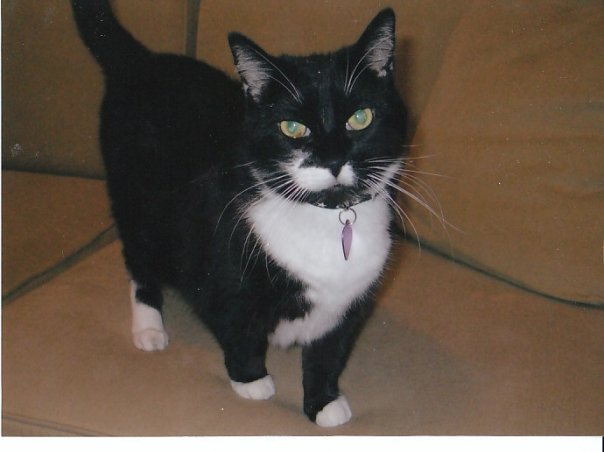
nin 3Nin is our 19-year-old cat.   Correction.  She is now HIS 19-year-old cat.  She looks like she is wearing a tuxedo, with her black body, white chest and milk mustache.   Her sexy, sleepy eyes reminded me of Anais Nin – ergo, her name.

We adopted her in 1999.  Our friend, Tim, arrived home that day from a year’s sojourn in Chicago.  He called from Tahoe to say he was on his way, and drove his truck straight to Berkeley to meet us for brunch.

After, the three of us wandered into the pet store next door.  And I walked out carrying cat number two.

According to my ex she’s having trouble using her back legs.  She can no longer pull herself up on the bed to sleep with him.  Today he came home and found she had peed all over herself.  As we were talking, she went to the litter box and simply lied in it.

Uncontrollable tears streamed down my face. “Put her down. Put her down.” I repeated the words over and over like a mantra.

He thanked me.  Said he needed to hear me say those words.  To make it ok.

Another piece of our shared life together fell away.

I thought about changing my course, turning around and going home.  But something wiser in me told me to keep walking, up the ramp and into the Lill Street Clay Studio.

Robert, my teacher, was giving a demonstration to the new class.

I wandered back to the carts holding fired pieces.  Some complete, some bisqued – waiting for glaze and a second fire.  I began the tedious and time-consuming process of locating my work – picking up every stoneware cup, bowl and tray, looking for the etched LMP on the bottom.

Melanie was doing the same.  She traveled to Seattle during our five-week class.  I sent her to Flora for dinner and Molly Moon’s for ice cream – honey lavender.  I was happy to see her.

Sifting through the pieces, I admired other’s work.  A deeply tinted bud vase, kissed with a tear drop of shiny blue.  A sculpted hand.  Melanie’s star-shaped badge, stamped with the word “rock.”  She wasn’t thrilled with how the glaze turned out.  I thought it looked awesome.

Kevin was there too.  A principal dancer with Hubbard Street and a fine beginning potter.  I got to know him a little bit one Saturday evening when we both went in to the studio to practice.  I watched bowl after bowl come off of his wheel while I just tried to master centering.  I never did.

And Lori.  We met a couple of weeks ago.  She was glazing a lidded pot with a brush.  She had etched cherry blossoms on to the side.  It was elegant.  Lovely.  The kind of work I dreamed of making but felt years away from.

That same evening, she showed me some tea cups she made.  Delicate cone shapes with carved out handles that looked like wood. Porcelain – glazed yellow salt.

She’s been throwing for just 10 months.  It looks like 10 years.

2013-08-03 16.47.16Eventually I found my pieces.  The slab tray buckled.  It was too thin.  But the bowl that Lori helped me glaze looked pretty good – my best piece yet.  She said my mug looked really good.  I told her it wasn’t my work, that Robert made it and gave it to me to glaze.  We laughed.

I told her about Nin and not wanting to glaze.

She told me about her best friend unexpectedly dying and how she wanted to cocoon but knew he wouldn’t want that.  That he would want her out in the street calling his name.  So she did.

We talked about pottery and writing and relationships.  She helped me glaze one of the mugs, filling the inside with one of the variety of whites.  And when it was dry we lowered it into a vat of rutile blue, then turned it upside-down and “kissed” the glaze a final time around the rim.

I watched her glaze several more lidded pots, a large tea-cup like the smaller ones she had shown me, and a tall, thin bottle – lowering it into the vat with her finger tucked inside.

I watched the patience and care she devoted to each piece.  I do not have that patience.  I am not so exacting.  At least not in this moment.  Not about pottery.  I realized this is what anything “good” requires – attention, time, care.

The same attention, time and care I take with my writing, my food, my clothing.  The same attention, time and care my ex takes with the cats, Nin and Maude.  The very reason I left them with him.

I put my pieces on the cart to be glazed.  Wrapped my finished bowl and tray in newspaper and put them in my bag.  I thanked Lori for her help and said goodbye to Melanie and Kevin.

Seems I wasn’t quite done.

Turns out, neither is Nin.  I talked to my ex.  He couldn’t get an appointment with a vet until Sunday.  He said she seems comfortable.  Slow, but comfortable.  Purring.  I trust him.  I trust his attention, time and care.  I always did.

Artist Date 32: In Between Dates. Some Things You Just “Know.”

2013-07-28 13.50.19I’m standing on the corner of 4th and Main in Royal Oak, Michigan.

I had breakfast with my old boss, Bill, a couple of hours ago.  We met at the restaurant he owns, where I used to work.  I was employee number seven.  Or maybe it was six? Nine?  We’re not exactly sure.  We decide seven sounds about right.

I haven’t seen him since my divorce.  Since he met DD.  We wax nostalgic about the early days.  Toast that came out 20 minutes after the eggs.  The decision to hire a cleaning service because I didn’t want to scrub the toilets.  The handsome photographer upstairs.

I spent years in this city.  As a teenager – thrifting and hanging out at Patti Smith – not the musician, the other one.  At her clothing store – talking, listening to music, wanting to be a grown up.

After college, I moved here and lived in an upstairs flat with my friend Mona and her two cats.  I worked at a weekly newspaper, waited tables on the weekends, and drank my tip money.

I haven’t been here in a number of years.  And alone, probably never.  It seems the perfect destination for Artist Date 32.  That’s what I had in my head when I planned my trip “home” a few weeks ago.  Except I didn’t make much time for alone.  I never do.

I just left coffee with my 17-year-old niece.  I found her waiting for me on a concrete planter outside of Caribou – which wasn’t Caribou when I was 17.  I remember “punk rock” kids getting dropped off here and walking down the street to meet their friends – as if their parents had not just dropped them off.

I tell my niece I used to hang out here 26 years ago.  She’s floored.  As she is when I tell her what 17 was like in my house.  That it wasn’t so different.  That I too felt grown up in so many ways, but still a kid in others.  How I just wanted to go – to New York..but Royal Oak would do.  And how sometimes I wanted to stay – in my bedroom with the blue shag carpet…forever.

Mostly, we agree that 17 is hard.

I’m due to meet Danny in a half hour.  We met at a Jewish retreat the summer before we entered high school.  He was funky and quirky and a good dancer – like me.  Perhaps he too felt like a black, drag queen trapped in a small Jewish body.

A half hour isn’t really long enough for an Artist Date, but I decide it’s kind of like exercise – a little bit is better than none.  I let go of all the “why didn’t you plan for your Artist Date” chatter and spend the next 30 minutes absorbing this place I used to call mine.  The clock is now ticking.

2013-07-28 13.47.12There used to be a bank here, just south of this corner.  I made out with Joe A. in my maroon Chevy Corsica, parked right in front of it.  He moved to Tucson not long after.

I see a guy sitting on the patio at Tom’s Oyster Bar.  He has the shiniest black hair I’ve ever seen.  Beautiful, with waves.  He looks like Joe’s musical partner – who I also made out with.  But later.  A couple of years later.  Just before I moved to San Francisco.  I cannot remember his name.  He looks up at me.  We smile at one another and he returns to his book.  I do not know if it is him.

So much has changed.  And yet, a lot is still the same.  The independent stores that serve as anchors –Haberman Fabrics.  Incognito.  Noir Leather.  I once bought an erotica book here and popped it in my lover’s bag before he headed out of town, with a dirty letter I penned tucked inside.

Bright Ideas – a modern, cool, functional interiors store.  It’s been here as long as I can remember.

I walk in and my head quiets.  I am sucked in by what is in front of me rather than what is in me, in my head –Joe A., his partner, my niece.

2013-07-28 13.54.46Detroit drink coasters.  Symbols of my childhood.  Drink Faygo Orange.  Better Made Potato Chips.  The iconic scrawl of Sanders – hot fudge and ice cream shops, and Vernors – better and spicier than any ginger ale you can imagine.  It used to be used medicinally.  Quintessentially Detroit.  All of it.  I am smiling.

There are tiny bud vases in a variety of colors, thrown on a potter’s wheel.  They began as a fundraising activity and blossomed into a business.  I think about my own somewhat disappointing foray into throwing.  Disappointing because I had expectations.  I thought I’d be good.  Immediately.  Because I worked with clay when I was 17.  Because I have no patience.

The vases are made in Seattle.  I am wistful.

There are low-slung couches with chrome and clean lines.  My nearly 5 foot 3-inch body sits comfortably in these.  At home my feet dangle off of the pricey futon.  I bought it because I had a notion that I would sleep on it and my bedroom would be my massage studio.  That’s not what happened.

I wonder if I can fit one in my hatch.

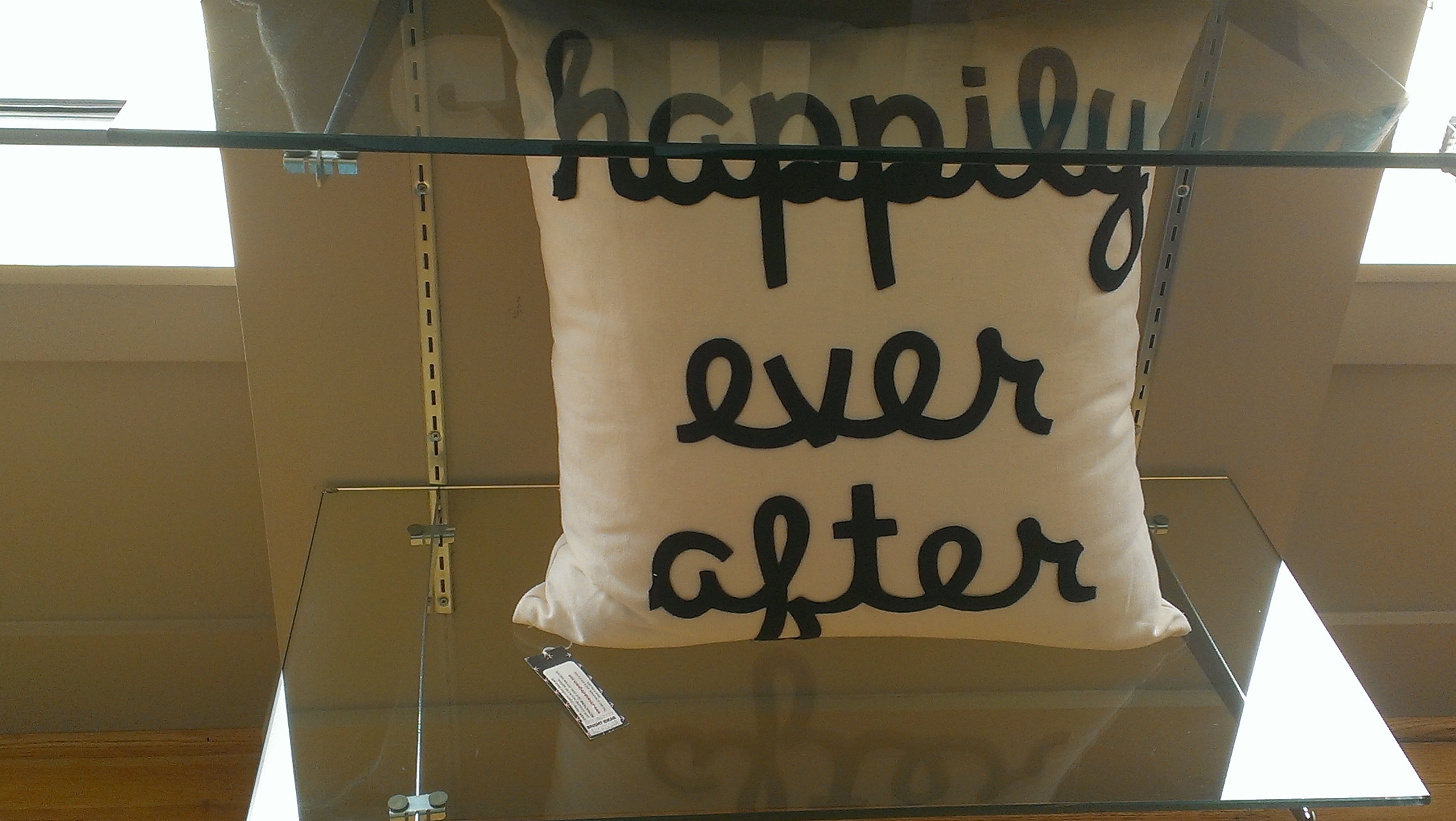
2013-07-28 13.47.28There are pillows with birds painted neon pink and green and blue.  An orange flower is growing out of another.  Several are felted, with messages “seemingly” just for me: “Let’s Make Out.”  “Happily Ever After.”  “Think Big.”  “Breathe.”

Yes. Yes. Yes and Yes.

2013-07-28 13.48.32There are yellow, leather “Star Trek” chairs.  Body hugging, with matching ottomans.  On the wall are grey circles with the letters S,M,L.  Like the three bears in Goldilocks.  I wonder which one will be just right for me.  In chairs.  In all things.

I look at my watch.  It’s time to meet Danny.  I feel surprisingly and strangely refreshed having taken these 20 minutes alone.  A little lighter.  A little clearer.  Time apart.

I find Danny down the street and throw my arms around him.  He is wearing a Grateful Dead T-shirt and shoots me a big smile – a cross between a 5-year-old’s pure joy and “I am up to no good.”

I tell him I’m hungry and he takes me to Astoria Bakery – formerly Cinderella’s Attic, one of my early thrifting haunts.  He orders a walnut roll.  I get a cookie laced with honey and a flirtation of anise.  His is better.

We catch up on our lives post-divorce.  He is a year ahead of me in the process.  He tells me about his kids.  About dating.  I tell him about not dating.  About my inability to compartmentalize.  My wish that I could.

I do not tell him about my Artist Dates.  I am not sure why.   I figure he already knows.  In the same way that I already know.  It’s just like that sometimes.  With some people.  In some places.  Like here, right now, with him.

Artist Date 31: He Played Debussy on my Naked Body. Believing in the God of Synchronicity

pianist of willesden laneLast week Stephanie W. invited me on an Artist Date.  This week Stephanie G. did.

However, unlike Stephanie W., who offered a suggestion – one that allowed me the prescribed solo experience of an Artist Date – Stephanie G invited me to join her and our mutual friend, Hallie, at the theatre.  Not solo.  Technically, not an Artist Date.

Yes, I spend this sort of time splitting these sorts of hairs.  As if the Artist Date police might show up at my door.  So I was relieved to read the following in Julia Cameron’s Walking in the World – her follow-up to The Artist’s Way, where I first became acquainted with the Artist Date.

In the section titled “Basic Tools,” Cameron writes:

“…the Artist’s Date…is assigned play…

“Synchronicity – that uncanny knack of being in the right place at the right time – picks up markedly as we practice Artist’s Dates.”

Stephanie’s invitation to The Royal George Theatre for The Pianist of Willesden Lane – Artist Date 31 –felt like that, like play, like synchronicity.

I’ve been thinking about music a lot lately.  My coffers crying out for sound.

I considered Harry Connick, Jr. at the Chicago Symphony.  Tickets were pricey unless I wanted to sit in the rafters.  Which I didn’t.  I wanted to see him.  Easy on the eyes, as my friend Teresa used to say.  Sitting in the gallery section would only frustrate me.

I considered a free concert at Millenium Park.  I considered a trip to the record store.

Yet I found myself in a woefully off-center, red-velvet theatre seat, flanked by Hallie on my right, and a mercifully empty seat on my left.  A Steinway Grand (Baby Grand?  Concert Grand?) and a handful of oversized frame mirrors on stage in front of me.

The Pianist of Willesden Lane is the story of Lisa Jura.  How her commitment and passion for the piano, along with the “kindness of strangers” and some sort of higher power – call it synchronicity – saved her life during World War II.  Written and performed solo by Jura’s daughter, Mona Golabek, The Pianist of Willesden Lane is told both in words and music.

Bach. Beethoven. Rachmaninoff.

Debussy.

I feel fingertips on my body.

I am lying in bed with the former symphony conductor.  He is playing the notes on my naked body – silky strains that sound like watercolor.  Ridiculously sexy.  He is teaching me about music.  Telling me about his life.  Interlochen.  Tanglewood.  Studying with Leonard Bernstein.

I have been assigned to write the obituary for his father – a kind-hearted, heavy-hitter in the community.  We speak over the phone.  He is funny, wry.  Smart and sweet.  I find a photograph of him in the files.  He has dark hair and a beard, bright eyes and a kind smile.  He is wearing a tuxedo.  I am smitten.

We meet through a series of synchronicities, and spend the next couple of weeks in bed – with Debussy, and frequently a pint of Ben and Jerry’s Mint Oreo Cookie.  I fancy myself “Mrs. Former Conductor.”  And then it is over.

I haven’t thought about him for a long time.  But my body remembers.

Like the Holocaust survivor I interviewed.  She lost her sense of smell during the war.  She regained it more than 40 years later when she returned to Germany.  She smelled manure.  Her body remembered.

I’ve been thinking of her ever since I saw Brighton Beach Memoirs a few weeks ago with my friend Michelle.  I told her how I had the great, good fortune to interview and tell the stories of so many Holocaust survivors when I worked for the Jewish Bulletin.

I don’t hear their stories much anymore.  Most of them are gone.  Until now.

Lisa Jura arrives in London from Vienna – one of thousands of children on the Kindertransport.  She is 14.

A few years later she is a student at the Royal London School of Music.  In the evening she plays piano in a hotel bar, where she meets many admirers.  Among them a Royal Air Force commander.

He is shy.  His English is poor.  His comrades approach her with a rose and act as his translator.

He says she is the most beautiful woman he has ever seen.  That she must tell him when she makes her debut.  And then he is gone.  Not just from the bar, but from London.  To war.

Lisa Jura and the Royal Air Force Commander.

And then it is over.  The war.  Just like that.

Miraculously, the commander is at her debut.  So are her two sisters.  They too have survived.

The lights go up.  Golabek steps out of Jura, and back into herself.  Post Script.  Lisa Jura immigrated to the United States.  The commander followed her, married her.  He is Golabek’s father.

I get teary.  Really teary.

I want to believe in ridiculously romantic love.  The kind I shared with the conductor.  The kind I had a glimpse of when a certain southern gentleman, upon learning I could not possibly see him again, pulled me close to him and said, “I’ll come find you.”

I want to believe in a God that allows three Jewish sisters to survive the Holocaust and then somehow find one another in post-war London.  Who then places two of them across the street from one another in Los Angeles.

I want to believe in Go(o)dness.  The go(o)dness of people who care for children that are not their own.  Who feed them.  Clothe them.  Shelter them.  Love them.  Foster their talent and dreams while a war wages outside their window.

I want to believe in the God of Synchronicity.  And I do.

Artist Date 30: Among the Flora, Invited Out

Stephanie
Stephanie

One of my readers invited me on an Artist Date.  Number 30.

Actually, she’s a friend…and a reader.  Her name is Stephanie.  Last week, she sent me an email inviting me to the Bucktown Tree and Garden Walk.  Hers would be among the 80-plus featured.

I was touched, delighted that she had somehow become “involved” enough in my story, in my process, to join in, to help me along.

So Saturday morning I pedal my vintage Raleigh to her neighborhood.  The day is sunny and hot, but not humid.  A Chicago miracle.

I tie up my bike at Club Lucky and buy a ticket for the walk. In exchange for $5, I receive a map of the gardens with descriptions of each, access to a complimentary trolley, and a coupon for $10 my next meal of $35 or more.

I hear my name called.  It is a woman I used to know.  I didn’t recognize her.  She isn’t surprised to see me.  She heard I moved back to town.  That I am divorced.  Chicago feels like a small town.  It is comforting.

We embrace.  And I jump back on my bike, headed to Stephanie’s, forgoing the trolley.

Her partner Errol is on the porch painting, plein air.  She is inside sautéing onions and baking a pizza – snacks for the other artists expected today.

She gives me a tour of her home, its walls spilling over with her artwork, Errol’s and that of other creatives.  Her first still life hangs in the stairwell.  It is a pear.  Or is it an onion and ramps?  There are several, grouped together.  I don’t recall.  In some ways it doesn’t really matter.  Her raw natural talent is obvious.  It is the kind that makes me wonder why I bother.

Stephanie and Toulousse
Stephanie and Toulouse

I meet her cat Toulouse, and a black one whose name escapes me.  He is missing some bone in his head, which makes his face appear somewhat smushed.

I leave my helmet and my basket with her, and receive explicit directions to stop by Sam and Nick’s.  She points out their location on the map.  “Just tell them we sent you.”

On the way I stop at my first floral garden, (Stephanie and Errol’s was planted with art – some framed and hanging.  Other funky and environmental.  A striped sidewalk created with a power washer and wood planks.  Painted sticks growing out of the soil.  Their colors “changing” from orange to green depending on your position.  Like a painting by the Israeli artist, Agam.)

Marsha is watering plants.  She seems surprised to see me.  Actually, many of the garden owners do.  As if they have forgotten that the garden walk is today.

She shows me her zinnias and her tomatoes.  Nothing remarkable, but lovely. Sweet.  Growing.

Walking into the private space of a stranger, I am reminded of being in Amsterdam.  According to my Frommer’s guide residents intentionally keep their shutters open – proud of their homes, inviting a peek inside.

This is Marsha’s first season in the garden.  She moved in recently, leaving the suburbs and joining her husband in the city.  Her house is on the market and she is keeping her fingers crossed.  She gives me hope – seeing her in this new space, putting down roots, with a partner.  And also knowing that she had a life all her own before this change.  And I assume, to a certain degree, still does.

I don’t tell her any of this.  Instead I tell her about my recollections of Amsterdam, how I recently killed a cactus, and about being invited on an Artist Date by her neighbor.  I run my hands through a tomato plant and bring them to my face.  I love the smell.  I rub my hands on my neck, as if putting on the earth’s fragrance.  I thank her and say goodbye.

2013-07-13 12.31.31

A wading pool is set up at the corner of Hoyne and Moffat, along with a glass bubbler filled with ice water, cucumber, melon and strawberries.  A few chairs are perched in the shade of a tree.  There is a note, “Relax and Hydrate.”  I fill up my water bottle and keep moving.

I stop at Nick and Sam’s.  Sam is wearing a white bee keeper’s hat.  I go inside and talk with Nick about his artwork.  Striking etchings using photos from the Kinsey Institute.  He points out the racy elements because I don’t see them – not at first.

I admire his collection of roller-skate cases lined up on a shelf, each with a tag hanging from it – letting him know what is stored inside.

I visit more than a dozen gardens.  Some consisting of little more than sod on a double-wide lot – one with a basketball net and cement court, another with a large inflatable swimming pool.  Two toddler girls in matching hot pink bathing suits and white sun hats are wading in it.  Their limbs, deliciously chunky.

Others sit on top of garages, tucked behind homes.

I follow arrows and stairs climbing up.  Water spills out of the wall and is caught in a ceramic bowl, a chalice.  Suspiciously clean, striped pads sit on top of teak furniture.  Several blue umbrellas block the sun.  A man, presumably the owner, offers me a bottle of water from a cooler.  I feel like I am at a spa.

At another, an intruder.  I am greeted by a man eating his lunch under a wooden canopy covered with vines, listening to the radio.  His daughter hangs shyly behind him, swaying side to side, her head following her hips.

Most of the homes are noticeably without “hosts.”  Only a laminated card, with a number corresponding to the map, identifies them as part of the walk.

I had expected storybook gardens, like something from the south.  Manicured.  Dense.  Sweetly pungent.  Or wild and overgrown, with tall, smiling sunflowers – like my favorite one in Mendocino, a sleepy resort town on the northern California coast.  A sign implores visitors to photograph, but to refrain from picking.

Instead I encounter mostly neatly trimmed hedges, modest groupings of plants and flowers that clearly thrive, creative use of small space —bringing nature into the city.

2013-07-13 12.54.05I remember moving to Chicago the first time, in 2007.  I was heart-sick for San Francisco.  For pastel-painted Victorians, rolling fog and rolling green hills.  I made it my mission to take the most beautiful path I could wherever I went.  The one with the most trees, prettiest homes.  I had forgotten about that.

Eventually I settled into Chicago.  My surroundings ceased to be new.  And I ceased to notice them.  Until today.

I return to Stephanie and Errol’s to pick up my things.  A few of Errol’s painter friends are here.  They ask if I am a painter.  I shake my head.  I tell them that I am a writer, a dancer, a frustrated potter.  A girl on an Artist Date, being reminded of the loveliness all around me.

Artist Date 29: Undressed

undressed
Degas’ “Woman at her Toilette”

I don’t recall ever having erotic musings at a museum.  Until today.

But I also don’t recall seeing a posting at the entry of an exhibit, a warning that explicit content lay ahead, possibly unsuitable for children.

But there it was.  And there I was in front of Felicien Rops’ “For You, General.”  A mild flush on my face –  Artist’s Date 29.

I returned to the Art Institute of Chicago for “Undressed: The Fashion of Privacy,” an adjunct exhibit to the newly opened “Impressionism, Fashion and Modernity,” which I saw last week – Artist Date 28.

I liked the name.  It reminded me of my strong belief in really good underwear – or none at all, which my friend Clover reminded me of when she was visiting last week.  She came out of the bathroom smiling.

“Right…really good underwear,” she said, referring to the lacy bits drying over the shower rod and towel bars.  We giggled knowingly.

There is very little underwear in “Undressed” – but a lot of vulnerable nakedness.

Sketches and paintings in all array of medium.  Women bathing.  Dressing.  Masturbating.  Breast feeding.

Mothers.  Prostitutes.  Children.  Defined spines.  Soft lines and folds of skin.

They remind me of something Geneen Roth wrote in her book When You Eat at the Refrigerator, Pull Up a Chair or 50 Ways to Feel Gorgeous and Happy (When You Feel Anything But).  Suggestion 25: Stare at Normal Women’s Bodies (Normal Does Not Include Models, Actresses, and Elite Athletes).

I’ve done this at women’s spas.  Sitting in the dry sauna, noticing dimpled thighs and buttocks.  Six-pack abs and round bellies – some large and pendulous, obscuring any hint of pubic hair.  Breast implants perched nearly at shoulder height.  Mastectomies.  Single and double, with and without reconstruction.

Pierced nipples.  Pierced navels.   C-section scars.  My own scars.  Two faded purple lines running vertically from my areolas to the folds under my breasts.

Sometimes I forget what real bodies look like.  How they move in the world.  I am reminded.

Degas’ “The Tub.”  A bronze sculpture of a woman submerged in water, her leg outstretched, washing her foot.

Klimt’s “Seated Woman from The Front with Hat, Face Hooded.”  Wispy lines of pastel pencil.  Her legs are spread and her hands are between them.  A large hat lazily tilted over her face.

debauchery-second-floor-1896_jpg!Blog

Lautrec’s ”Woman in Bed – Waking.”  She is turned toward me, one sleepy eye just opening.  Sexy.  Soft.  So different from his prostitute in “Debauchery” –a hazy, colored drawing of a woman being groped from behind.  His hands over her breasts.  Her arm extended, a martini-shaped glass dangling from her hand.

There are men too.

Delacroix’s “Standing Academic Male Nude.”  Chiseled.  Holding a stick, he appears to be rapping it onto his flat hand –a threatening gesture.  As if preparing to punish some innocent, or not so innocent.

As if HE is the general Rops’ alludes to in “For You, General” – an old woman holding a younger one over her knee, her buttocks exposed, an offering.  The girl’s bunched up skirt covers her face.  The old woman is smiling.

boys bathing

Munch’s “Boys Bathing 1896.”  Like tadpoles.  “Boys Bathing 1899.”  Like many letter X’s, like many little frogs.  “Men Bathing.”  Like figures from a Hatch Show Print poster –iconic wood-block images made in Nashville, announcing the Grand Ole Opry and Johnny Cash.

There are children.  Rafaelli’s “Germaine At Her Toilette.”  A young girl in a white dressing gown, her black tights wrinkled and baggy at the knees.  Even religious icons.  Munch’s “Madonna,” like an album cover or t-shirt from a 70’s rock band.  Bands of colors tracing her image.  And who is the small character in the bottom left corner, seemingly questioning all of this?

Edvard_Munch_-_Madonna_-_Google_Art_Project_(495100)I notice the few pieces by women. Just  a few — always.  Suzanne Valadon sketches.  Mary Cassatt paintings.  Her style is bright.  Animated.

I peer deeply into black and white woodcuts.  I love their simplicity, their precision.  And yet, I am not quite sure what I see.

I come close and step away and come close again.  It reminds me of the drawings on the back page of children’s magazines.  The ones that ask “Do you see the old woman or the young woman?”  Where once you see one, it is impossible to see the other.

It is the same with Vuillard’s “The Birth of Annette.”  Finally, after many minutes, I see the baby’s head.

Perhaps that is the point.  The experience of “Undressed,” of being undressed, is so intimate, so private.  I am an invited voyeur.  It is not mine to fully know.

Artist Date 28: Me, Kate Moss and the Joannes

kate mossAbout this time last year, my friend Joanne told me she had two style icons – me and Kate Moss.  I was surprised and tickled.  But mostly tickled.

I remember  what I was wearing that day.  A tight pink and white striped “French sailor” t-shirt from Old Navy, with buttons along the boat neck.  Too loose, Army-green cigarette pants from Target, purchased prior to my ex asking me for a divorce – before the weight slipped off of me, seemingly overnight.  A thin, woven belt, and my yellow peep-toe wedges with ankle straps.

I felt like a page torn from Glamour –“Great Looks for less than $50,” or something like that.  Minus the shoes.  The shoes would put me “over budget.”

The shoes always put me over budget.

“What calls for the most care in a woman’s costume is unquestionably the foot gear and the gloves.”

The words are stenciled on a wall at the Art Institute of Chicago, along with numerous other pithy statements about dress.  I am here for a member lecture and pre-viewing of “Impressionism, Fashion, and Modernity” – Artist Date 28.

Sometimes I feel light, superficial, because I am delighted by statements like Joanne’s.  I feel that it should not matter.

And yet, I am at a show that has toured the Metropolitan Museum of Art in New York and the Musee d’Orsay in Paris before landing in Chicago, a show that is focused on fashion.  Earlier this year I saw another, “Inspiring Beauty: 50 Years of Ebony Fashion Fair,” at the Chicago History Museum.

I consider that, perhaps, how I choose to cover my body might not be a simple matter of practicalities and aesthetics.  That fashion – how we dress ourselves, individually and as a culture – is in fact, a statement of sorts.  A reflection of time, mood, politics.  Think hemlines rising as the economy upticks.

Or, as Gloria Groom, the show’s curator says in her lecture, “clothing is not fashion.”

The exhibit is bursting with paintings and sketches.  Advertising, bits of clothing and accessories.   Bustles, corsets, shoes.  Costumes for walking the boulevards of Paris.  For going to the sea.

“As fashion was an integral part of Paris’ character, some places – the boulevard, parks, racetracks and theatres – were constructed with the idea of it’s well-dressed pubic in mind.”

Groom ends her lecture with a joke, a “warning.”  That those experiencing a bad hair day, clothing day, face day, might do well to avoid the exhibit.  That mirrors and reflective surfaces abound.

I am standing in front of a collection of hats.  Fifty or more.  jeweled.  Feathered.  Contained in a single square of plexiglass spanning floor to ceiling.  I see myself admiring the millinery.  Recognizing one that reminds me of the hat I wore at my wedding.  I mention this to the woman standing next to me.  She asks me about it.

It is made of tightly woven straw, pinned up into corners, decorated with ribbon flowers and glass fruit.  I had to have it.

I do not mention I am divorced.  It does not feel germane.   We are talking about hats.  This is progress.

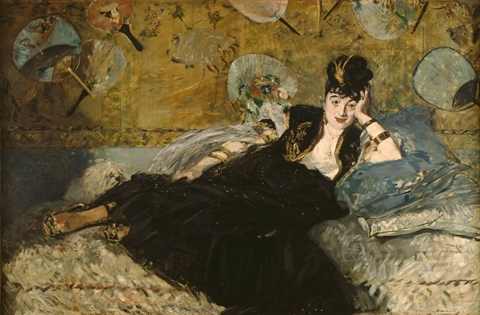
Manet-Lady-with-Fans_480My marital status creeps in later, standing in front of an Edouard Manet painting of Nina de Callais, called “Lady with Fans.”  She is lying on her side, looking straight into the camera.  If there were a camera.  Her eyes are big, dark, open.

She is dressed in black, but she is not mourning.  She is wearing jewelry.  If she were in mourning she would not be, Groom explains.  Groom adds that de Callais is divorced.  That perhaps she is “re-baiting the trap.”

The placard next to the painting notes that de Callais was known for hosting salons of writers and artists.

A woman next to me says, to no one in particular, “She is ugly.”  I do not agree.  “Don’t you think she looks and sounds like fun?” I say.

“Perhaps.  But she is ugly.  At least she is painted that way.”

I say nothing.  Like my friend Julie says, “You can’t argue with crazy.”

I wonder if I am re-baiting the trap.  Maybe.  Not long after I moved back to town, my friend Tori commented that I dressed differently – sexier, more body-conscious.  I wasn’t conscious of it.  But now I am.

There are corsets.  Boudoir paintings showing seductively naked shoulders and upper backs, napes of necks teasingly exposed.

“A woman in a corset is a lie, a falsehood, a fiction.  But for us, fiction is better than reality.” 

I think of a party I attended in San Francisco in the mid- 1990s.  There is a poster of the Dallas Cowboy Cheerleaders, circa 1976, hung in the bathroom.  By today’s standards, and even those of almost 20 years ago, the women – once considered the pinnacle  of beauty in America – would be seen as flabby, soft.  Their breasts, saggy.  Their thighs, heavy.

Like the photograph of Marilyn Monroe that was recently popular on Facebook.  She’s in a yellow bikini. Boy short bottoms. Tie halter top (I covet this suit.).  She is reclining.  Folds of skin naturally line up across her belly in horizontal rows.

I have folds across my belly.

I am acutely aware of the phenomenon of Photoshop.  Of airbrushing.  That no celebrity would willingly allow this photograph to surface.  But that it might show up in The Star or The Inquirer, with a headline like “Monroe Hits Maximum Density.”

It is a little after 4.  I have given myself an hour to tour the exhibit.  It is not long enough.  I have somewhere to be.

I want to stay and stare at the woman in the Frederic Bazille family reunion painting.  The one in the polka-dot dress staring out at me.  Her face is sweet.  It is shaped like mine.

I want to take off my shoes and run my feet through the fake grass covering the floor in the Plein Air (open air) room.

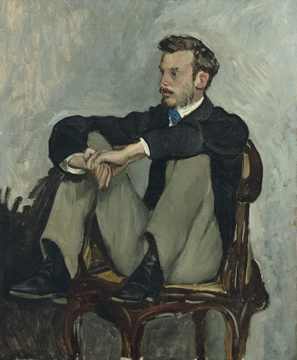
Bazille-Renoir_360I want to lean into Bazille’s portrait of Pierre-Auguste Renoir.  Hiked up on a chair, his arms wrapped around his bent knees.   He is bearded.  My type.

I want to scroll through Henri Somm’s sketchbook, digitally brought to life.

I want to see the related exhibits: “Undressed: The Fashion of Privacy” and “Fashion Plates: 19th-Century Fashion Illustrations.”

I return home and there is a message from my friend Joanne.  A different Joanne.  She was at the lecture too.  She saw me.  I saw her.  But we didn’t see each other seeing one another.  She says, “You looked lovely in that dress.”

I wonder what this dress – its halter-style, plunging neckline and flirty skirt, covered in large red and navy flowers – says.  Is it a sign of optimism, worn the day before the Supreme Court overturns the Defense of Marriage Act?  Or is it nothing more than a response to a sticky, summer day in Chicago?