Artist Date 33: Done. Saying Goodbye to Nin.

nin

I didn’t want to glaze tonight.  I was done.

Done.

With my day.

I’d already snagged decidedly gorgeous, flimsy, French panties and bras on sale.  Seen a Tina Turner impersonator on Michigan Avenue.  A pretty good one.  And connected in that profound way that strangers sometimes do with Yahkirha, a Red Cross worker fundraising across from Millenium Park.

Done.

With my pottery class.

It ended two weeks ago, but I still had two mugs and a woefully off-center bowl to glaze and finished pieces to pick up.

So I went, anyway.  My ex called while I was walking there.  As soon as I picked up, I knew something was off.  I could hear it in his voice.

“I have to put Nin down.”
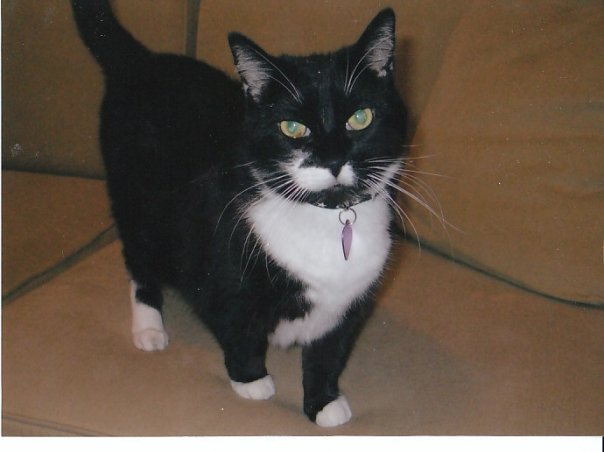
nin 3Nin is our 19-year-old cat.   Correction.  She is now HIS 19-year-old cat.  She looks like she is wearing a tuxedo, with her black body, white chest and milk mustache.   Her sexy, sleepy eyes reminded me of Anais Nin – ergo, her name.

We adopted her in 1999.  Our friend, Tim, arrived home that day from a year’s sojourn in Chicago.  He called from Tahoe to say he was on his way, and drove his truck straight to Berkeley to meet us for brunch.

After, the three of us wandered into the pet store next door.  And I walked out carrying cat number two.

According to my ex she’s having trouble using her back legs.  She can no longer pull herself up on the bed to sleep with him.  Today he came home and found she had peed all over herself.  As we were talking, she went to the litter box and simply lied in it.

Uncontrollable tears streamed down my face. “Put her down. Put her down.” I repeated the words over and over like a mantra.

He thanked me.  Said he needed to hear me say those words.  To make it ok.

Another piece of our shared life together fell away.

I thought about changing my course, turning around and going home.  But something wiser in me told me to keep walking, up the ramp and into the Lill Street Clay Studio.

Robert, my teacher, was giving a demonstration to the new class.

I wandered back to the carts holding fired pieces.  Some complete, some bisqued – waiting for glaze and a second fire.  I began the tedious and time-consuming process of locating my work – picking up every stoneware cup, bowl and tray, looking for the etched LMP on the bottom.

Melanie was doing the same.  She traveled to Seattle during our five-week class.  I sent her to Flora for dinner and Molly Moon’s for ice cream – honey lavender.  I was happy to see her.

Sifting through the pieces, I admired other’s work.  A deeply tinted bud vase, kissed with a tear drop of shiny blue.  A sculpted hand.  Melanie’s star-shaped badge, stamped with the word “rock.”  She wasn’t thrilled with how the glaze turned out.  I thought it looked awesome.

Kevin was there too.  A principal dancer with Hubbard Street and a fine beginning potter.  I got to know him a little bit one Saturday evening when we both went in to the studio to practice.  I watched bowl after bowl come off of his wheel while I just tried to master centering.  I never did.

And Lori.  We met a couple of weeks ago.  She was glazing a lidded pot with a brush.  She had etched cherry blossoms on to the side.  It was elegant.  Lovely.  The kind of work I dreamed of making but felt years away from.

That same evening, she showed me some tea cups she made.  Delicate cone shapes with carved out handles that looked like wood. Porcelain – glazed yellow salt.

She’s been throwing for just 10 months.  It looks like 10 years.

2013-08-03 16.47.16Eventually I found my pieces.  The slab tray buckled.  It was too thin.  But the bowl that Lori helped me glaze looked pretty good – my best piece yet.  She said my mug looked really good.  I told her it wasn’t my work, that Robert made it and gave it to me to glaze.  We laughed.

I told her about Nin and not wanting to glaze.

She told me about her best friend unexpectedly dying and how she wanted to cocoon but knew he wouldn’t want that.  That he would want her out in the street calling his name.  So she did.

We talked about pottery and writing and relationships.  She helped me glaze one of the mugs, filling the inside with one of the variety of whites.  And when it was dry we lowered it into a vat of rutile blue, then turned it upside-down and “kissed” the glaze a final time around the rim.

I watched her glaze several more lidded pots, a large tea-cup like the smaller ones she had shown me, and a tall, thin bottle – lowering it into the vat with her finger tucked inside.

I watched the patience and care she devoted to each piece.  I do not have that patience.  I am not so exacting.  At least not in this moment.  Not about pottery.  I realized this is what anything “good” requires – attention, time, care.

The same attention, time and care I take with my writing, my food, my clothing.  The same attention, time and care my ex takes with the cats, Nin and Maude.  The very reason I left them with him.

I put my pieces on the cart to be glazed.  Wrapped my finished bowl and tray in newspaper and put them in my bag.  I thanked Lori for her help and said goodbye to Melanie and Kevin.

Seems I wasn’t quite done.

Turns out, neither is Nin.  I talked to my ex.  He couldn’t get an appointment with a vet until Sunday.  He said she seems comfortable.  Slow, but comfortable.  Purring.  I trust him.  I trust his attention, time and care.  I always did.

Artist Date 31: He Played Debussy on my Naked Body. Believing in the God of Synchronicity

pianist of willesden laneLast week Stephanie W. invited me on an Artist Date.  This week Stephanie G. did.

However, unlike Stephanie W., who offered a suggestion – one that allowed me the prescribed solo experience of an Artist Date – Stephanie G invited me to join her and our mutual friend, Hallie, at the theatre.  Not solo.  Technically, not an Artist Date.

Yes, I spend this sort of time splitting these sorts of hairs.  As if the Artist Date police might show up at my door.  So I was relieved to read the following in Julia Cameron’s Walking in the World – her follow-up to The Artist’s Way, where I first became acquainted with the Artist Date.

In the section titled “Basic Tools,” Cameron writes:

“…the Artist’s Date…is assigned play…

“Synchronicity – that uncanny knack of being in the right place at the right time – picks up markedly as we practice Artist’s Dates.”

Stephanie’s invitation to The Royal George Theatre for The Pianist of Willesden Lane – Artist Date 31 –felt like that, like play, like synchronicity.

I’ve been thinking about music a lot lately.  My coffers crying out for sound.

I considered Harry Connick, Jr. at the Chicago Symphony.  Tickets were pricey unless I wanted to sit in the rafters.  Which I didn’t.  I wanted to see him.  Easy on the eyes, as my friend Teresa used to say.  Sitting in the gallery section would only frustrate me.

I considered a free concert at Millenium Park.  I considered a trip to the record store.

Yet I found myself in a woefully off-center, red-velvet theatre seat, flanked by Hallie on my right, and a mercifully empty seat on my left.  A Steinway Grand (Baby Grand?  Concert Grand?) and a handful of oversized frame mirrors on stage in front of me.

The Pianist of Willesden Lane is the story of Lisa Jura.  How her commitment and passion for the piano, along with the “kindness of strangers” and some sort of higher power – call it synchronicity – saved her life during World War II.  Written and performed solo by Jura’s daughter, Mona Golabek, The Pianist of Willesden Lane is told both in words and music.

Bach. Beethoven. Rachmaninoff.

Debussy.

I feel fingertips on my body.

I am lying in bed with the former symphony conductor.  He is playing the notes on my naked body – silky strains that sound like watercolor.  Ridiculously sexy.  He is teaching me about music.  Telling me about his life.  Interlochen.  Tanglewood.  Studying with Leonard Bernstein.

I have been assigned to write the obituary for his father – a kind-hearted, heavy-hitter in the community.  We speak over the phone.  He is funny, wry.  Smart and sweet.  I find a photograph of him in the files.  He has dark hair and a beard, bright eyes and a kind smile.  He is wearing a tuxedo.  I am smitten.

We meet through a series of synchronicities, and spend the next couple of weeks in bed – with Debussy, and frequently a pint of Ben and Jerry’s Mint Oreo Cookie.  I fancy myself “Mrs. Former Conductor.”  And then it is over.

I haven’t thought about him for a long time.  But my body remembers.

Like the Holocaust survivor I interviewed.  She lost her sense of smell during the war.  She regained it more than 40 years later when she returned to Germany.  She smelled manure.  Her body remembered.

I’ve been thinking of her ever since I saw Brighton Beach Memoirs a few weeks ago with my friend Michelle.  I told her how I had the great, good fortune to interview and tell the stories of so many Holocaust survivors when I worked for the Jewish Bulletin.

I don’t hear their stories much anymore.  Most of them are gone.  Until now.

Lisa Jura arrives in London from Vienna – one of thousands of children on the Kindertransport.  She is 14.

A few years later she is a student at the Royal London School of Music.  In the evening she plays piano in a hotel bar, where she meets many admirers.  Among them a Royal Air Force commander.

He is shy.  His English is poor.  His comrades approach her with a rose and act as his translator.

He says she is the most beautiful woman he has ever seen.  That she must tell him when she makes her debut.  And then he is gone.  Not just from the bar, but from London.  To war.

Lisa Jura and the Royal Air Force Commander.

And then it is over.  The war.  Just like that.

Miraculously, the commander is at her debut.  So are her two sisters.  They too have survived.

The lights go up.  Golabek steps out of Jura, and back into herself.  Post Script.  Lisa Jura immigrated to the United States.  The commander followed her, married her.  He is Golabek’s father.

I get teary.  Really teary.

I want to believe in ridiculously romantic love.  The kind I shared with the conductor.  The kind I had a glimpse of when a certain southern gentleman, upon learning I could not possibly see him again, pulled me close to him and said, “I’ll come find you.”

I want to believe in a God that allows three Jewish sisters to survive the Holocaust and then somehow find one another in post-war London.  Who then places two of them across the street from one another in Los Angeles.

I want to believe in Go(o)dness.  The go(o)dness of people who care for children that are not their own.  Who feed them.  Clothe them.  Shelter them.  Love them.  Foster their talent and dreams while a war wages outside their window.

I want to believe in the God of Synchronicity.  And I do.

Artist Date 29: Undressed

undressed
Degas’ “Woman at her Toilette”

I don’t recall ever having erotic musings at a museum.  Until today.

But I also don’t recall seeing a posting at the entry of an exhibit, a warning that explicit content lay ahead, possibly unsuitable for children.

But there it was.  And there I was in front of Felicien Rops’ “For You, General.”  A mild flush on my face –  Artist’s Date 29.

I returned to the Art Institute of Chicago for “Undressed: The Fashion of Privacy,” an adjunct exhibit to the newly opened “Impressionism, Fashion and Modernity,” which I saw last week – Artist Date 28.

I liked the name.  It reminded me of my strong belief in really good underwear – or none at all, which my friend Clover reminded me of when she was visiting last week.  She came out of the bathroom smiling.

“Right…really good underwear,” she said, referring to the lacy bits drying over the shower rod and towel bars.  We giggled knowingly.

There is very little underwear in “Undressed” – but a lot of vulnerable nakedness.

Sketches and paintings in all array of medium.  Women bathing.  Dressing.  Masturbating.  Breast feeding.

Mothers.  Prostitutes.  Children.  Defined spines.  Soft lines and folds of skin.

They remind me of something Geneen Roth wrote in her book When You Eat at the Refrigerator, Pull Up a Chair or 50 Ways to Feel Gorgeous and Happy (When You Feel Anything But).  Suggestion 25: Stare at Normal Women’s Bodies (Normal Does Not Include Models, Actresses, and Elite Athletes).

I’ve done this at women’s spas.  Sitting in the dry sauna, noticing dimpled thighs and buttocks.  Six-pack abs and round bellies – some large and pendulous, obscuring any hint of pubic hair.  Breast implants perched nearly at shoulder height.  Mastectomies.  Single and double, with and without reconstruction.

Pierced nipples.  Pierced navels.   C-section scars.  My own scars.  Two faded purple lines running vertically from my areolas to the folds under my breasts.

Sometimes I forget what real bodies look like.  How they move in the world.  I am reminded.

Degas’ “The Tub.”  A bronze sculpture of a woman submerged in water, her leg outstretched, washing her foot.

Klimt’s “Seated Woman from The Front with Hat, Face Hooded.”  Wispy lines of pastel pencil.  Her legs are spread and her hands are between them.  A large hat lazily tilted over her face.

debauchery-second-floor-1896_jpg!Blog

Lautrec’s ”Woman in Bed – Waking.”  She is turned toward me, one sleepy eye just opening.  Sexy.  Soft.  So different from his prostitute in “Debauchery” –a hazy, colored drawing of a woman being groped from behind.  His hands over her breasts.  Her arm extended, a martini-shaped glass dangling from her hand.

There are men too.

Delacroix’s “Standing Academic Male Nude.”  Chiseled.  Holding a stick, he appears to be rapping it onto his flat hand –a threatening gesture.  As if preparing to punish some innocent, or not so innocent.

As if HE is the general Rops’ alludes to in “For You, General” – an old woman holding a younger one over her knee, her buttocks exposed, an offering.  The girl’s bunched up skirt covers her face.  The old woman is smiling.

boys bathing

Munch’s “Boys Bathing 1896.”  Like tadpoles.  “Boys Bathing 1899.”  Like many letter X’s, like many little frogs.  “Men Bathing.”  Like figures from a Hatch Show Print poster –iconic wood-block images made in Nashville, announcing the Grand Ole Opry and Johnny Cash.

There are children.  Rafaelli’s “Germaine At Her Toilette.”  A young girl in a white dressing gown, her black tights wrinkled and baggy at the knees.  Even religious icons.  Munch’s “Madonna,” like an album cover or t-shirt from a 70’s rock band.  Bands of colors tracing her image.  And who is the small character in the bottom left corner, seemingly questioning all of this?

Edvard_Munch_-_Madonna_-_Google_Art_Project_(495100)I notice the few pieces by women. Just  a few — always.  Suzanne Valadon sketches.  Mary Cassatt paintings.  Her style is bright.  Animated.

I peer deeply into black and white woodcuts.  I love their simplicity, their precision.  And yet, I am not quite sure what I see.

I come close and step away and come close again.  It reminds me of the drawings on the back page of children’s magazines.  The ones that ask “Do you see the old woman or the young woman?”  Where once you see one, it is impossible to see the other.

It is the same with Vuillard’s “The Birth of Annette.”  Finally, after many minutes, I see the baby’s head.

Perhaps that is the point.  The experience of “Undressed,” of being undressed, is so intimate, so private.  I am an invited voyeur.  It is not mine to fully know.

Artist Date 27: SHAME Throwing

What I was doing when I thought I'd be "throwing..."
What I was doing when I thought I’d be “throwing…”

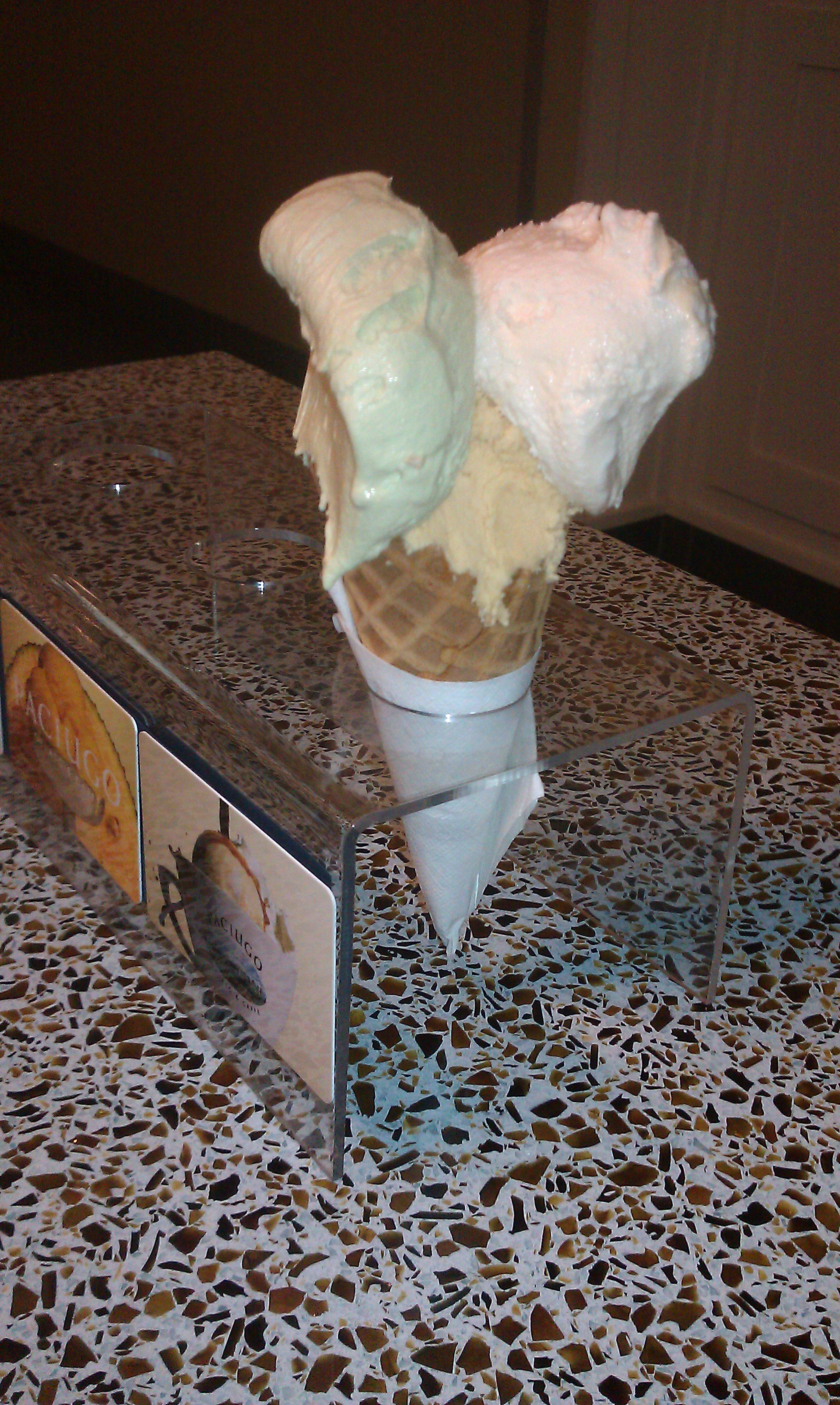
I just got home from a gelato date.  Three flavors is a piccolo (small).  I filled my cone with pistachio-almond, yogurt-granola and rose and sat in the square watching children run back and forth and forth and back over a star pattern on the ground – my friend Ernie took a picture of me in this space when he was visiting in the fall.  He thought it was a Star of David and wanted me in the center.  It isn’t.

The sky is pale blue, silky – like underwear.  Clouds like cotton.  The weather has been unsettled for the past two days, and I too, along with it.

I feel acutely alone in this moment, which is strange as I spent the better part of the day with people I love.

During the winter I often spent Saturday nights alone – by choice.  I looked forward to cozying in, midnight blue outside my window – cooking, writing, sprawled out on the shiny, moss-green futon.  Summer feels different, like all the world is out – together.

I remember when my friend Teresa found herself “suddenly single” after a many-years long relationship.  Understanding why, on Monday, I was making plans for Saturday.  “If you don’t, you end up alone,” she surmised.

And yet, I chose this “alone” – for Artist’s Date 27.  But I never quite made it.

I thought I’d throw pottery at Lill Street Art Center.  I attended my first, First-Time Potter class on Wednesday.  Studio time – every day from 10 to 10—is included in the fee and students are encouraged to go practice.

But I didn’t go.  I talked on the phone with Chase, then Monica.  I went for gelato.  I told myself, and Chase, that I was tired.  That I needed to take it easy.  Maybe.  But mostly I think I was afraid.

What if I don’t remember how to start the wheel?  What if I can’t get the tray that sits around the wheel collecting water to snap into place?  (I had trouble on Wednesday.)  What if the wheel is running in the wrong direction – clockwise, like how they throw in Japan, instead of counter?  I vaguely remember Robert, the instructor, telling us the wheel turns in both directions, to make certain it is running counter-clockwise.  He did not tell us what to do if it is not.

My friend Mark recently told me an acronym for SHAME.  Should Have Already Mastered Everything.  Genius.

I get caught up in my pride and it stops me from moving forward.

And yet, I am moving forward.  I signed up for the class.  I went.  I kind of sucked – I certainly had not Mastered Everything.  And I loved it.

I was afraid that night too.

Afraid I wouldn’t be able to tolerate the painful callous that developed on the side of my hand the last time I tried to learn to throw.  Afraid I wouldn’t like it.  Afraid I would be an utter failure.

I didn’t develop a callous.  The wheel wasn’t painful against my skin.  Different clay, I was told.

I wasn’t an utter failure.  Two of four pieces will be fired and glazed.

I did like it.  All of it.

Will the final week of class look like this?

Buying my supply kit and writing my initials on each piece with a Sharpie marker, my full name on my blue water pail.  Picking up a 25-pound bag of clay and splitting it with a partner – separating the four vertical logs from one another, each of us taking two.

My clay “partner” is here with two of her friends.  They just graduated from high school and live in the suburbs.  One of their mothers dropped them off here.

They seem so young, so brave.

I run a wire twice through my logs and place four disks of clay in front of me.  Robert teaches us to wedge the clay, to take the air out of it and prepare it for use.

I roll one wedged disc into a ball, stick a thumb in the center, and form a pinch pot.  As we get acquainted with the clay, we introduce ourselves, sharing a bit about what brought us to this moment, this studio, this canvas table.

There is a couple taking the class together.  A woman who just moved from Minneapolis and thought this would be a good way to meet friends.  A woodworker.

I mention that I always wanted to go to art school.  That at 43 I can send myself.  The words tumble out of my mouth.  They feel profound, true.

I remember my friend Robyn saying our parents tie our shoes until we can tie them ourselves.  Throw us birthday parties until we can throw our own.

Robert moves to a wheel and we gather around him, watching him craft a simple bowl.  He shows us how to throw the clay on the wheel – “throwing” pottery.  How to center.  How to bring it up, bring it out.  He tells us to keep our clay wet.  Shiny.

We nod our heads.  Fill our buckets with water and go to our wheels.  My mind is blank.  I put my foot on the pedal.  Nothing.  The woodworker is sitting next to me.  He smiles and points to the “on” switch.  I smile back.

I throw the clay and press it down, pour water on the wheel.  I am having difficulty bringing it up.  Robert shows me how.  The bottom is too thick.  He shows me how to thin it out.

It is rising.  It looks good.  I don’t stop.   It collapses onto itself.  I throw it onto a board and put my initials in the clay with a tool.  I will let it dry out and re-wedge it to use again.

My second bowl goes better.  It is small.  Imperfect.  A reasonable effort.

Robert calls us to him again and demonstrates another bowl.  It makes more sense now that I have been on the wheel.  We return to our stations.  I remember things he has said.  To angle my finger at 5 o’clock to widen the bowl.  It feels like arriving home for the first time in a new city, without getting lost.  Without using a GPS

My third bowl collapses onto itself.  The fourth joins my second on a piece of wood, hydroplaned on.  I cover it with dry-cleaning plastic wrap and put it on my shelf – the one assigned to me for the next four weeks.

Cleaning up, I watch the potters in the advanced classes.  Their work is beautiful.  Elegant.  Effortless.  Perhaps I will be like them one day.  I am over my SHAME.  I know there is no reason to believe I Should Have Already Mastered this.  Or anything else.  Not even my Artist Dates.

Artist Date 26: Some Kinda Love

10 poems to set you free

I have come to crave myself.

The words surprise me.

It is subtle.  A quiet yearning.  It doesn’t scream with white-hot fervor.  It is not that impulsive.

It guides, rather than drives, me.  Less a need, more of a desire – a siren calling with patient intensity.

I am not certain I have felt this way about anyone.

But how could I?

I’ve been “seeing’” myself (pun intended) for six months now.  Twenty-six Artist Dates.  Half a year.

This is my third-longest relationship, the longest being my ex-husband, followed by my first real boyfriend – who I dated for just shy of a year.  The others have been days, weeks, a couple of months.  Until now.

Some dates are exciting, juicy, aimed to impress – the Lyric Opera, Steppenwolf Theatre, the Joffrey Ballet.  Others are simpler, without fanfare or tickets.

Saturday is the latter.

I am on my way to the Conrad Sulzer Library in Lincoln Square.  An Artist Date return destination.  I want to read poetry.  Anne Sexton poetry.

I’ve been chipping away at her biography for several weeks, renewing it twice from the library, and paying $7.50 in overdue fines.  I read a chapter each night before bed.  I had been reading old journals.

One detailing a love affair with a man I imagined was beyond my reach.  Movie star handsome.  Devilishly sexy.  With a name to match.   Fantasy sex.  It was 19 years ago.  I had forgotten.

Another notes that I have stopped reading.  Stopped writing.  I have been dating my now ex-husband for one month.  My therapist has called me out on this.

In many I have written” I want to drink.”  Again and again.  I know I can’t.  But I don’t know how to not.  Not yet.  I lament the end of early love.

A trusted friend suggested I put the journals away.  At least for now.  An exercise in being fully present.  It’s been Anne and I, mostly, ever since.

I imagine poring over, pouring myself into, her work.  To Bedlam and Part Way BackAll My Pretty Ones?  Love Poems?  I’m not choosy.  Whatever is on hand.  I want to go to the source.  To the one who now keeps me up late at night.

But there is no Anne Sexton here.  None of her writings, that is.  Most of it is housed at the Harold Washington Library downtown, the one with the huge gargoyles on the roof.  I’ve yet to go inside there.

Plan B.

I roam the poetry stacks.  Ten Poems to Set You Free, by Roger Housden.  Lofty promise.  I’m intrigued.  Hopeful.   I grab it, find a seat near a window – near the jigsaw puzzle half done, inviting patrons to add a piece to its completion— and begin to read.

My head softens.  Opens.  Like when I meditate.  I didn’t realize I had a headache but now it is starting to clear.  It is quiet.  Blessedly quiet and I am blessedly alone, reading – once again.  Like I used to.

“Shake off this sadness, and recover your spirit; sluggish you will never see the wheel of fate that brushes your heel as it turns going by…the only thing which lasts is the work; start then, turn to the work.  Throw yourself like seed as you walk, and into your own field,” Miguel de Unamuno

“Don’t be satisfied with stories, how things have gone with others.  Unfold your own myth, without complicated explanations, so everyone will understand the passage, We have opened you.  Start walking toward Shams.  Your legs will get heavy and tired.  Then comes the moment of feeling the wings you’ve grown, lifting.” Rumi.

The poetry is like prayer, each word a meditation.

My nose feels hot.  My nostrils flare.  My eyes are wet.  Emotions greeting my senses.

“And who will care, who will chide you if you wander away from wherever you are, to look for your soul?”  Mary Oliver.

No one, I whisper.

“Quickly, then, get up, put on your coat, leave your desk!”

I cannot move fast enough.  Suddenly I know that I’ve come here only to receive my map and my marching orders.  Not to stay.  Not today.  My soul isn’t in this place.  It is outside the window.

In the park across the street where 10-year-old boys are playing baseball; where parents and grandparents, aunts and uncles, sit in folding chairs, drinking beer and soda, watching.

In the gelato shop where this date began.  Where I let cinnamon and toasted coconut and sea salt caramel play on my tongue.

I rush down the stairs, adding myself to the check-out queue.  Quickly, it is my turn.  “Come on down,” the librarian cries.  “I don’t watch the Price is Right since Bob Barker retired,” I say.  She laughs.  Neither does she.

I rush out into the sun that made itself known just an hour ago, after a wet, grey morning.  The air is hot and thick.  Moist.  Steam rising up out of the sidewalk.

I cross the street, walking into the park I pass nearly every day, but have never stepped inside of.  I find a quiet bench, mostly, and continue reading.

“…don’t mourn your luck that’s failing now, work gone wrong, your plans all proving deceptive – don’t mourn them uselessly…say goodbye to her, the Alexandria that is leaving.  Above all, don’t fool yourself, don’t say it was a dream, your ears deceived you: …go firmly to the window and listen with deep emotions, but not with whining, the pleas of a coward; listen – your final delectation – to the voice, to the exquisite music of that strange procession, and say goodbye to her, to the Alexandria you are losing.” C.P. Cavafy.

I read the words again, flummoxed.  Surprised.  Affirmed.

My experiences are real.  All of them.   No matter how long or short.  No matter if another understands or believes.  Each is real because I felt it, thought it, lived it.  It is true.

This is what I hear.

Celebrate it.  Honor it.  Mourn it.  Give it a proper send off.

The former symphony conductor.  My traveling companion in Germany.  The horny artist from New York.

The photographer, fantasy-sex lover, from journals 19 years old.

My ex-husband.

I savor each word, read them over and again – like a mantra offering me permission, I tenderly hold each little love.  Precious.  Complete.  Over.

I lie down on the bench and close my eyes.  I feel the sun blanket my body.  Lie on me heavy, like a lover.  Church bells merge with traffic and the dull empty whack of a bat hitting ball.  Clapping.  Squealing.  A man is doing lunges on the cement patch in front of me, groaning.

I walk home slowly, eyeing the cute boys on Lincoln Avenue.  They do not look back at me.  They never do, I think.  And then, “Lesley, that is simply not true.”  My own voice.

I walk into my apartment, turn Pandora to Lou Reed.  He sings to me.  Straight to me, through me.  Always.  I bypass songs, one, two, three, four, five.  Six, I cannot bypass.  “Some Kinda Love.”  It is what I had hoped to hear.  God is with me in the little things.

I chop onions and garlic, cook them with wild cod, capers and tomatoes, grill a side of bright green asparagus.  I sit at the table.  Cloth napkin.  Sunflowers in a vase.

Some kinda love.

Artist’s Date 25: Following Breadcrumbs and Cleaning Up My Insides

Andrew-Gilliatt-April-2013-60-300x300
Bowl by Andrew Gilliat

I believe in “following the breadcrumbs.”  Like Hansel and Gretl, noting the obvious signs and trusting that I will always be led – if I listen.

I was on the fence about my destination for this week’s Artist Date – Number 25.  My friend Kiki mentioned she might drop by a reception at Lillstreet Art Center – one of my considerations.  Her noncommittal musing was just enough to point my compass.

I’ve been to Lillstreet just once before, for a fundraiser.  I imagined I would return here often, but I have not.  I pass it all the time and I think about going in.  I pour over the website trying to decide which class to sign up for.  I am intimidated and ultimately do nothing.

This is ironic as I am greeted by a most friendly staffer at the door.  She tells me the photography show opening today, Midwest Contemporary, is on two floors.  That beer is on the main floor, wine is on the second – in case that helps guide my decision in terms of where to begin.  It doesn’t.

But the pottery does.  Porcelain slab platters etched with lines that look like a teenage girl’s cutting.  Bowls and plates covered with repeating whimsical patterns.  Forks and knives, swings, balloons and birds in matte glaze. 

I’ve considered the First-Time Potter class here but have been leaning toward Drawing-into-Painting.  Pottery is messy and I don’t really have “pottery clothes.”  I can draw anywhere.  Yet I keep picking up the fired clay.  Running my fingers over it.  Cupping it in my hand.

I remember ceramics class in high school.  Mr. B and I argued about everything – even about how often I peed.  He said I was a sloppy student.  That I didn’t clean my edges, my insides.  It sounds true – of my work.  Of my blurry boundaries and the messy parts inside of me.

I did craft beautiful pieces in his class though.  A platter with a teal drip glaze.  A coil vase with a long neck – large and genie-like, big enough for Barbara Eden to pop out of.  My mother displays both of them in her home.  

I look up toward the photography on the wall – my chosen medium in college until I switched my major from fine art to journalism.  There is a large, creepy photograph of a doll’s head – battered and old.  I don’t like it.  I read the artist’s statement.  She photographs vintage dolls.  The cracks in their exteriors representing the broken parts in us all – some that might never be “fixed” in this lifetime.  I still don’t like the picture, or the doll’s eyes.  But I like the idea of it.

There is work from an artist who earned his MFA from Michigan State University – my alma mater.  It wasn’t known for its art department when I was a student.  I wonder how it has changed.

There is another of a trailer park along the Russian River in California with a big Paul Bunyan figure looming over the camp.  It is part of a series chronicling the photographer’s vacation destinations as a child.  I’m pretty sure I’ve been here.

I wander up to the second floor.  There is a second photograph of trailers, this one from Williston, North Dakota.  Hydraulic fracking boom town.   Michael and I drove through here on our way back to Chicago from Seattle.  It reeked of testosterone and crystal meth.  Unsettling.

There is a photograph of a young African-American man looking straight into the lens.  Into me.  The photographer is from Saginaw, Michigan – where my mother grew up. 

midwest contemporary show
“Elliot,” by Sarah-Marie Land

I feel alone.  I go downstairs , returning to the pottery, and strike up a conversation with another woman, also alone.   She likes the bowls and goblets adorned with animals.  Anything with animals, she says.  I do not, but say nothing.   As the room fills up I am acutely aware of my single-ness.  I think about staying and listening to the live music, but I’m not sure where to perch myself.

I decide to leave instead. 

This is the first time my Artist Date feels lonely, that I don’t feel filled up by it.  On the way out I stop and talk briefly with the friendly staffer who greeted me.  I remember Kiki mentioning her friend’s reception is private, on the roof – that I would have to ask to get up there.  So I do.

I am directed to the back of the building, through the music and pottery and photography, through double doors. I ask a tall man/boy with a red beard and glasses if this is the way to the roof. He says yes and we climb the stairs together. Two of mine for every one of his.

It is sunny and clear.  People are drinking wine.  I do not see my friend.  I turn to go back down.  The bearded man/boy says, “Yep.  A lot of roof.”   We walk down together.  I am not sure why he has come here.  I ask him if he has a studio here.  He does not.  He peels off to a classroom on the third floor and I go down to two.  There are open artist studios.  I missed them my first time up. 

I walk into one.  There are slabs of clay with what looks like hieroglyphics on them.  The artist is talking with a couple about her work and they rope me into conversation.  I ask about the tall, smooth pieces with wild insides.  They are wide.  Almost as big around as I, and climbing higher than my waist. 

Each represents a character from Shakespeare’s “The Winter’s Tale.”  The blue queen is smooth outside, but inside “she is mourning.”   I see it.  I see the glazed clay crying inside, rounded discs turned down upon themselves like leaves.  I wonder if this is what I look like inside.

A second character is smooth and orange-y outside, fiery and sharp inside.  She is angered by how the king has treated the mourning queen.  A third is green.  A girl child left in the woods, raised by a shepherd.  She is smooth inside as well as out.  Peaceful.

I return to a jewelry studio I couldn’t make my way into before.  Too small.  Too many people.  Edith Robertson is talking with a friend.  She has a blonde-ish/white-ish bob and turquoise eye liner.  She immediately greets me, inviting me to try on whatever I like.  She puts her hand on my arm.  Warm.

I pick up a choker made of gathered strands of thin wire with a long crystal hanging from it.  It looks like a stalactite. Or is it a stalagmite?  A piece of lapis lazuli adorns the back side – a hidden surprise.

I think of my friend Julie and the days I spent with her after her mother died, offering massage and bodywork to her family.  Of her friend Karen whisking me off to her house, plopping me into an overstuffed chair and placing a crystal in each hand. 

The effect was immediate.  Electric.  Like a volt of energy seizing my body.  I imagined smoke coming off of me, as if I had fried a chip.  I was out.  When I awoke about 20 minutes later, I felt like I had been put back together.  I wonder if this crystal would do the same for me.

Edith and I quickly realize our paths have been crossing one another for the better part of 30 years.  In Detroit.  In San Francisco.  And now in Chicago.  That the universe has been conspiring for us to meet.

She tells me that making jewelry is her second act.  I tell her about mine.  About my Artist Dates and my return to writing.  We talk about Germany – her birthplace.  The first place I traveled overseas.   She has the same last name as my ex-husband.

We talk until a couple walks in and I hand her over to them.   I sign her guest book, leaving her with my email address and her necklace.  Perhaps another time. 

I walk down the stairs and out the door, thinking about connections.  About clay classes and cleaning up my edges, my insides.  About breadcrumbs.

Artist’s Date 24: Finding “Epic” Acceptance

epic flyingWhen I was about eight, my parents took me to see The Black Stallion at the Keego Theatre, a movie house where they played second-run shows for a buck.

Onscreen, a storm is raging.  Passengers of a luxury liner jump into life rafts.  A young boy cuts free an agitated, tied-up horse, and it leaps from the boat.  The horse’s angry owners hold the boy at knife point before he is flung into the dark, choppy waters.

I am hysterical.  Sobbing.  Unable to catch my own breath.  I do not know the horse will rescue the boy.  That the story is just beginning.

My mother pinches me under the arm.  “Do we have to go out to the car?” she asks.

My feelings are too big for my family.  This is what I believe, true or not.

It is why I often watched television upstairs in the guest room, alone – my emotions leaking out with Folgers commercials and documentaries on PBS.  It was a source of teasing – mostly good-natured – in my family.  But I was too sensitive to realize it.

Sitting in the Davis Theatre watching Epic – Artist’s Date 24 – I remember all of this.  The fear.  The anxiety.  The shame that is tied to these feelings.  I am experiencing it now.

I’m old enough to know that good will prevail.  This is a PG movie.  I know that the Leafmen will “win,” that the pod will bloom in the full moon, that the forest will be saved.

And yet.

There’s this loud, foreboding music.   Crescendo rising.  Bats flying.  Forest dying.

The Images are dark.  Mandrake, nemesis of the forest, of life itself, wears a rat skin like a hooded cape.

I feel my heart quicken, a desire to turn my eyes away.  I am afraid.  I do not trust it will end well.

I am the only adult in the theatre without a child in tow and I feel a little bit self-conscious.  I retreat to my head.  Do the parents think I am suspect?  A child molester?  Why aren’t the children afraid like I am?

A dad ducks and scurries out, gripping two little hands, one in each of his.  Are they frightened?  Or do they have to pee?

epic flowersI saw the trailer for Epic a few weeks ago, on another Artist’s Date.  I was enchanted by its beautiful images – flower-people, with heads like cotton pom-poms, dandelions turned to seed.  Faces on sunflowers and gerbera daisies.  I was called by its questions about belief.

This is what brought me here, on a day I find myself emptied out, running on fumes – the promise of loveliness.  Of faith.  Of possibilities.  This is what I receive:

Professor Bomba’s unshakeable belief in something he can’t see, but only knows.  Like God.  Like Horton Hears a Who.  His willingness to be perceived as crazy.  His willingness to lose seemingly everything for his belief.

The Leafmen’s simple code, “Many Leaves.  One Tree. You are Never Alone.”

I learn that love can bloom riding gently on a deer.  And a pod that blooms in full-moon light is the source of all creation.  That hummingbirds make great horses, but common brown sparrows can do the job too.

I am reminded that relationships between fathers and daughters are sometimes hard.  And that it’s ok to hold on to someone you hardly know – if they offer you a hand or a torso and you need one.

That each of us has a purpose – even slugs and snails.  We might not know it.  Don’t always ask for it.  But we can embrace it.  And continue to put one foot in front of the other.

That life is about finding out what we are capable of.  How high we can jump to get ourselves out of a hole.  And that each of us can learn to fly.

That we all experience loss.  Of a parent.  Of a friend.

And that sometimes, love comes back – oftentimes in the most unorthodox and unexpected of ways.

Queen Tara’s energy, twinkling light like Tinkerbell, speaking to Ronin and to MK after she has left this-worldly plane.

MK’s reunion with Nod, straddling “normal” and Lilliputian-sized worlds for the promise of connection, of love.

I think of my own recent reunitings, seeing someones I never thought I’d see again … and then did.

The tears stream down my face.  Gratitude.  Beauty.  Joy.  I feel their salty release.   I notice them, like I notice the fear, and do nothing.  I let them roll off of me in the darkness.  I can sit with them.  They are not too much for me.

Artist’s Date 23: Seeing The Angels Who Have Stayed

The woman sitting next to me reeks.

Her two friends wave and come down the aisle to greet her.  One comments on how wonderful she smells.  She asks if it’s (insert name of fancy perfume here as I can’t remember it).  It is, she says, adding that she can only buy it in Paris now.  It’s no longer available in the United States.

“High class problems,” as my friend Dina likes to say.

She is coughing uncontrollably into a hanky.  Hacking,really.  She says she has been sick for weeks.  This is her first outing in as long as she can remember and she’s not even sure she can make it through the whole performance.

I am seething.  I say nothing.  I pray to myself, “Bless her.  Change me.”  My friend Dina taught me this too.  I say it like a mantra until the lights go down.

It is cold in here.  I pull on my wool hat.  It is May.

This is good.  I am not thinking about what I am going to write.  Not thinking that I have committed to 52 Artist Dates and that this is number 23.  I am simply “in it,” observing its smells, sounds, and temperature.

I am at Steppenwolf Theatre Company to see Head of Passes.  I’ve never been here before, but I know that it is a Chicago must – both a jewel and an institution.  The play has received good reviews.  Tickets were $20 plus a $7 handling fee on Goldstar.  When my friend Mimi called to cancel our plans, I took it as a sign and hit “purchase.”

head of passesOn the way here I have one of those “my life is really cool” gratitude moments.  I am driving to the theatre on a Thursday night, by myself, as casually as I might be driving to Trader Joes – as if “this is what I do.”  And it hits me, this IS what I do.  I fill my creative coffers every week.

They say it takes 30 days to create a habit.  I am only on day 23.

I pull into the garage as I realize I can’t feed the meters for the length of the performance.  $10.  A date would pay, right?  Why not me?  This has become my guiding principle – would someone who liked me do this for me?  If the answer is yes, I do too.  Another new habit.

The boy at will call is cute.  He hands me my ticket – second row, off-center to the right.  Awesome seats – illness and odor directly to my left notwithstanding.

The writing is good, rich with wonderful lines that make me laugh uncomfortably like, “Black people don’t like the rain.”  Another about the folly of loving something, someone, who is going to leave you.

Then I am full of folly.  My heart is big and shiny and open.  And someone is always leaving.  Through death, divorce, moving, changing.  I don’t take it as personally these days.  Not like when I was 18 and thought I was the only one experiencing the pain of loss.

I am sitting at my grandmother’s house with my mother and father.  They have come to visit me at university, and together we visit her, my father’s mother, who lives just a few miles away.  She and I are not close.

This visit is more painful than usual because the man I have lost my virginity to has left East Lansing for a spring internship in Illinois.  I am heartbroken.  He is gone.  He was never really there in the first place.  He is engaged, or engaged to be engaged, to a girl in his hometown.  I am not his only indiscretion.

My mother tells me these visits are hard for her too.  That she misses her own mother, my Nana.

“Everyone leaves me,” I sob, making it suddenly all about me.  Nana.  Bill, my red-headed Mr. Wrong.  My friends see him in the cafeteria and shake their heads.  They don’t see what I see.  He wanted me.  It was enough.

Selah laughs sweetly at the doctor – at his folly, for allowing himself to care for her, to be saddened by her imminent death.

But she doesn’t die.  Her children do – tragic, senseless deaths.  Two boys, now grown, delivered by the doctor. And a girl, also grown, brought to Selah as an infant by her husband, the father.

He reminds me of my red-headed Mr. Wrong.  He didn’t bring me a child, just a sexually transmitted disease.  I loved him anyway.  And Selah loved this girl, raising her as her own.

But first, the house collapses onto itself.  Onto Selah.

She emerges, covered in a white choir robe.  Her hair is closely cropped, like mine.  Her matronly dress and braided wig lost.  She is conducting church services – for herself, by herself.  She is the choir, the audience and the minister, all at once.  Her faith, if not her mind, intact.

In the final scene Selah slips back through the rabbit hole of sanity and out of the condemned house, assisted by a construction worker in a hard hat, a dead ringer for the angel who has visited her throughout the two acts.

I think of my own angels – the ones who have taken me by the elbow, guiding me out of my own mess, too many to name.   No longer focused on who has left – not even the woman to my left – I can clearly see who has stayed.