Artist’s Date 20: When God Fills the Space, a Trip to the Island of Lost Souls

Luana_Danse_Savage-Small__07477_std“You look familiar.  Are you famous?”

This is an auspicious beginning to any date – even an Artist’s Date, one that I take by myself.

I assure Eric, the salesperson at Blackbird Gallery and Framing, that I am not.

“I love this,” he continues, gesturing to my bindi.  “All of this,” he adds, waving his hands in small circles around his face.  “You are beautiful.”

I like this man.  Of course, he is gay.

In my hand is a cardboard tube.  I’ve made a handle out of packing tape so I could carry it from Nashville to Knoxville to Atlanta and home to Chicago.  Inside are two posters.

I bought them at Hatch Show Print in Nashville – America’s oldest working print shop – where letterpress posters summoned me through glass.  Where nary a square inch of wall isn’t covered with iconic images of Johnny Cash, Patsy Cline and the Grand Ole Opry.

A smattering of them are for sale, among them “Luana. Danse Savage” and “Island of Lost Souls with the Panther Woman.”   As soon as I spotted them, I knew they were mine.

Eric unrolls them onto a large table and places weighted felt bags at each corner so they lie flat.  They are made of heavy cotton paper, printed in single color ink.  Luana is deep purple – women dancing in short fringed skirts, with cuffs around their ankles.  Island of Lost Souls with the Panther Woman is forest green – a vamped-out, busty broad holding a wild cat on a leash.

Island of Lost Souls.  I feel like I took up residency there about a year ago.  I often times still feel wayward.  Uncertain.  Acutely aware that little in my life has stood on terra firma for some time now.

Island_of_Lost_Souls_01__08149_stdMarriage dissolved.  Another move cross-country, this time bringing little with me that feels like home.  At the time it felt liberating – packing the 13-year-old Honda Civic and leaving the rest behind.  Only later did it register as frighteningly impulsive and potentially foolish.

And yet, my ex doesn’t seem to feel any less lost than I – living in the house where we once lived together, sleeping in the bed we used to sleep in together, surrounded by “our things.”  Perhaps I got the better end of the deal.  Spiritually, at least.

I like the panther on the poster.  And the va-va-voom dress the woman is wearing.  A sexy new take on Cat Woman.  The possibility of living as a super hero.

Luana reminds me of Sunday afternoon dance class at the Old Town School of Folk Music.  Of the serendipity and just plain good luck I had to dance with a troupe in Rwanda this past summer.  The dancers’ surprise and delight that the muzungo (white person) could follow.

Luana seems the opposite end of the Island of Lost Souls.  Yet I am both of them at once.

The posters are big.  Big enough to make a dent on my big, blank canvas of a wall – painted  eggshell by my landlord.  The colors, the same as those in the fabric hanging on the adjacent wall – a few meters cut and carried from the Rwandan market.

They are not what I had envisioned here.
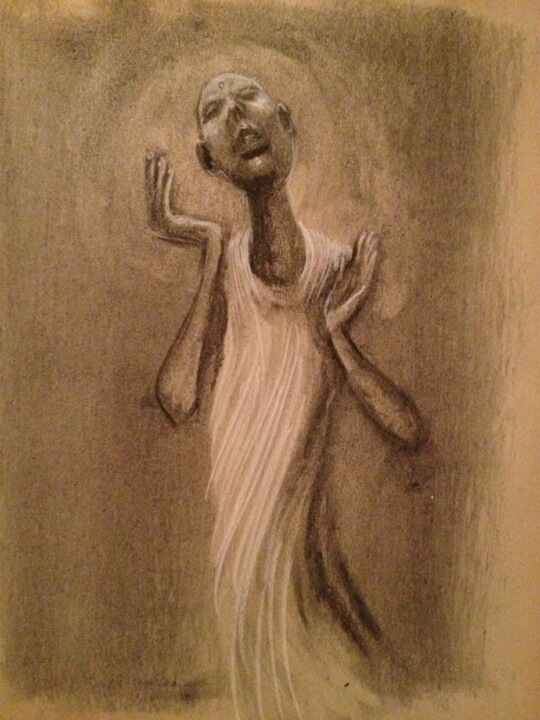
slade painting of meI had imagined my friend Slade’s sketch of me.  Shaved head, bindi, a whitish aura around me – he is not the first to comment on it.  I look a little bit African American, a little bit Hare Krishna.  Thin, wispy, spiritual.  I love it.  I love how he captured me.  But the piece is small, and it lives in his sketchbook.

I had imagined a map.  Or a series of maps, playing off the unintentional travel theme of the room.  Snowshoes on one side of the entry way, license plates from California, Washington and Illinois on the other.  Stacked suitcases turned on their side make a table.  There’s the Rwandan fabric, and a painting I bought from my friend Scotty of a woman leaving her home, leaving her tribe.  It’s called, “You Can Take it With You.”

I am amazed at how the space is filled when I let go of my ideas and make room for God.

Eric and I lay frame corners on the edges of the posters.  Painted wood.  Maple. Birch.  No.  Not quite.  I place a sample of metallic sage on one, metallic plum on the other.  A marriage is made.

Eric places a card on top of the posters.  It shows the differences between three types of glass.  Three price points.  I submit to the middle grade.  Less reflection.  Less distortion.  UV protected.

We talk about spacers and decide I can do without.

Eric crunches numbers and square inches.  I look at paintings and photographs on the walls.  The artists are young, accomplished – as evidenced by their bios.  Talented.  I feel woefully far behind in my craft.  As if I’ve been losing time for some time.  On that Island of Lost Souls for far longer than I realized.

He produces a framing estimate that shocks me.  Even with my $61 Yelp! coupon credit it is much more than I anticipated.  I consider leaving and sticking a tack into Luana and the Island.

I think about all the things I left behind so that I could create something new.  Something shiny.

I hand over my credit card and put down a deposit, hoping the second half will show up on next month’s bill.

I tell Eric about the posters.  About dancing in Africa in the middle of a divorce, leaving the Island of Lost Souls for a spiritual sojourn.  He tells me about his photography work.  We talk about my return to writing.

Perched up on a three-legged stool, I realize I am flirting.  It doesn’t matter that he is gay.  I feel light.  Like myself.  Or who I used to be.  I enjoy our easy rat-a-tat-tat repartee.

I ask him his sign.  Sagittarius, he says and I laugh.  I should have known.  I tell him I love Sagittarians.  I do not tell him that the book Love, Sex and Astrology says that Libra and Sagittarius meet at half past 7 and are in bed by 8.

I keep this to myself, along with stories of all the Sagittarians I have loved – my first real boyfriend in college.  My one-time drinking partner.  My religious studies professor – the object of my unrequited desire for so many years.  Unfinished business.

Instead, I tell him I am a Libra.  He tells me I seem strong.  Resilient.  I smile and nod.

“Sometimes,” I say.

After nearly an hour with Eric, I leave with a pink receipt and a card for his next open studio.

As I cross the threshold on the way out, a couple walks in with a large piece of art for framing.  So large it requires both sets of hands.  Divine timing.  God filling the space I am leaving.

My Last Conversation With My Birth Mom. Part Two.

My birthmother and I.  Our first meeting.
My birthmother and I. Our first meeting.
I said I didn’t remember my last conversation with her, but that isn’t exactly true.  For truly, the last one — the most recent — was on Sunday, Mother’s Day, after her funeral.

After I met my Uncle Thom for the first time.  The one who called me when she was dying and when she did die.  Who I knew from Facebook and with whom I share a special connection.  Who, after we embraced, said, “Come, meet the rest of your family,” and introduced me to uncles and cousins and spouses while I wept behind my sunglasses.

After I met her friends from the Daughters of the American Revolution.  The ones who told me how happy they were for our reunion.  The ones who knew every nuance of our story.  The ones who said I looked “just like my mother.”  And whom I felt no need to correct with terms like “birth” or “biological mom.”

After I introduced myself to the minister and he threw his arms around me and pulled me to him.

I hadn’t made it to town in time for the viewing.   The funeral was closed casket.  My Aunt Julie made arrangements for me to see her at the funeral home after the ceremony.  Before I went in, I called her and asked if I might tie a red thread around Pharen’s wrist, like the one I wear.

I explained in Kabbalah, mystical Judaism, this thread represents protection.  That one wears it on her left wrist, the pathway of the artery to the heart.  That one was placed on me after my Jewish divorce so that I would be reminded of what I am moving toward.  For me, it is greater love.  I didn’t know what it would be for Pharen.

She gave me her blessing and suggested I ask the director for help putting it on her.

We slipped the thread over her clawed hand and I tightened it.  The skin of the dead feels strange.  Rubbery.  I didn’t like it.  I felt badly about that.  And then the director left me alone.

The thread didn’t go with her outfit.  She was dressed in a gorgeous beaded suit, with a beaded clutch in her clutch.  She had chosen this outfit some time ago and had discussed it in detail with Aunt Julie and I — all the way down to the pantyhose.  I was surprised, but I shouldn’t have been.  Though born in Detroit, she had become a Southern lady, after all.

I told her that I met the rest of the family.  That I was staying with my friend April, who I had met last time I visited.  That I would be seeing the boy we had talked about.  That he and I had fallen into a beautiful and loving friendship, yet still I was anxious I might not see him.

I told her about meeting her friend Ely.  That I said she had great style and she said I did too.  That we discovered we shared a few things in common.

To all of this she said, “I know.”

I apologized for the times that it was hard between us.  The times I put up walls.  The times that I was afraid.  Afraid she’d jump into my skin given half a chance.  I did not apologize for the boundaries I learned to set for myself.

I apologized that the red thread didn’t match her ensemble but mentioned I thought she would like the idea of us having matching bracelets made of string.

I told her I called Robert, my birthfather, and let him know of her passing.

And I sang to her, just like I did in the hospital and on the phone.  Ain’t No Mountain High Enough.  Gypsy.

“You come from far away with pictures in your eyes…”

And then I pulled up a chair and I listened.  She told me she loved me about a thousand different ways.  And she told me that I knew what to do.  And that was all.

I left knowing that it had all already been said — when she was alive.  And if perchance I had forgotten something, that I could tell her anytime.  And if I”m quiet and lucky, and if I believe, I will hear her response.

Likely another, “I know.”

My Last Conversation With My Birth Mom. Part One

My birthmom as a girl, in the blue.  My ex says I look just like her.
My birthmom as a girl, in the blue. My ex says I look just like her.

I don’t remember my last conversation with my birth mom.

I remember a brief talk we had from the car, when she told me to call her when I could sit down and really talk.  I did, a few days later.  But I don’t quite remember what I said.  Or what she said.  Something about paying bills.

I had gotten used to the idea that she would be around for a while.  I had forgotten she was sick.

A little more than six months ago I got a call that she was in the hospital, unresponsive.  That if I wanted to see her before she died, it was time to go.  So I went.

By the time I arrived in Charleston 36 hours later, she was sitting up, drinking chocolate milk — the occasional expletive flying out of her mouth.  She was “fine.”

But she wasn’t fine.  She was hooked up to tubes and machines.  She looked frail.  The doctors were pushing her to make decisions about the end of her life.  She wasn’t having any of it.

I had imagined sitting next to her, stroking her hand and telling her everything I never got a chance to tell her and wondering if she heard any of it.

Instead, we had a dance party in her room.  I danced.  She held  my hand.  We listened to Motown — naturally.

I sang to her and rubbed her feet and we talked about boys — the one I had just met, the one that was my biological father, the one I used to be married to.

She told me she had written my ex off as “dead,” as she and her friends were wont to do.  Fiercely protective of me.  I told her she didn’t have to.  That he was a good man.  “But he hurt you,” she said.

“It’s ok.  I’m ok,” I said.  And she softened.

And yet, when I left her I was certain I wouldn’t talk to her again.  Wouldn’t see her again.  Neither turned out to be true.

We continued our conversations as she was moved from hospital to hospital to rehabilitation center to home.  None of us believed she would ever go home, let alone live another six months.  But she was determined.  And when Pharen got an idea in her head, it was hard to derail her.

And so, over a six month period, I was lulled into a sense of security.  A belief that she would “be there.”  Our conversations felt less dramatic.  Less desperate.  Less “this might be the last time we talk.”

I was surprised when I got the call that she died. And yet, there was a peace in not knowing our last conversation would be just that. That we could just talk, like people do. Like we had learned to do. 


Artist’s Date 21: Not Quite Alone at the Opera

opera glassesI called my friend Sheila from the Lyric Opera tonight.  I was seeing Oklahoma!   Artist’s Date 21.  Standing in the lobby, talking into my corded ear piece, I told her I felt at ease here by myself.  That it didn’t seem strange.  That I was comfortable.

Perhaps because I had been on 20 solo Artist’s Dates prior.

Or perhaps because I wasn’t really alone.

I got a call this morning.  My birth mother, Pharen, died.  She was 60.

We just met for the first time three years ago.  She had been looking for me for 12 years, but it wasn’t until I began my search for her that we were connected.  And then it was ridiculously and remarkably fast.  And easy.

We spoke for the first time two days before I turned 40.  I was on a plane to Charleston to meet her a few months later.

During that visit she gave me a pair of mother-of-pearl opera glasses — one of the few things she had to give me, she explained, apologizing that she had long ago given her “good jewelry” to her nieces, as she wasn’t sure she would get to meet me.

I patted the lump in my bag that was the glasses, tucked inside a soft purple Crown Royal bag.  Exactly how she gave them to me.

Sweet irony.  For it is only in getting sober that I finally mustered the courage to look for her rather than talk about looking for her.  That I found friends who had done the same and could walk me through it, step by step.

Sweet irony.  That I would be going to the opera the day she died.

My friend Lynn told me to be gentle with myself during this time.

This time when my stomach feels full with anxiety and yet I don’t know what I am anxious about.  She says it is my body responding to the uncertainty of experiencing something new.

Like losing a “parent” — even if she didn’t raise me.  Or going to the opera alone.

My body has grown accustomed to these Artist’s Dates.

Picking up my tickets from will call, I felt kind of cool and confident, like the girl in a Charlie! perfume commercial from the 1980s.  “Who’s that in the orange suede boots and short, pink-wool blazer by herself?   The one with the bindi and the cropped hair?”

I used to sometimes feel sorry for people I saw alone at events.  I don’t anymore — because I don’t feel sorry for me.

I settled into my aisle seat — main floor, row RR — relieved that I didn’t have to make conversation.  That I could sit.  That I could read from the book in my bag.  That I could return emails and texts from my smartphone, clicking “like” by every condolence I received on Facebook.  Right until the lights went down and the curtain went up.

I’d never seen Oklahoma! before, movie or stage production.  I loved it.  Who doesn’t love a surrey with a fringe on top?  I pulled out  my glasses to see the performers better.  I had a hard time getting a really clear view, but no matter.  I felt her with me.  I wasn’t alone.

I loved the simple story of courting and coupling — a different time, but the foibles and heartbreaks universal, transcending it.  I saw a little bit of myself in wildly flirtatious Ado Annie.  Always keeping her options open.  Easily swayed by pretty words and sexy kisses.

I thought of my Aunt Julie, Pharen’s sister, who I met this fall when I went to Charleston a second time — when I received a call that my birth mother was dying, but didn’t.

I had met a boy while I was there and fell head over heels over head.  And when it didn’t turn out exactly as I had planned, she warned me about “pretty words.”  And to “stop and pay attention” when I hear what I want to hear, words that make my heart race.

Aunt Julie is practical and wise.  Pharen was like me.  A dreamy romantic with her heart on her sleeve and her feet often-times not quite touching the ground.

I loved the singing.  I loved the dancing.  I loved that it was light and I could just smile through it.

I loved that I could, in fact, smile through it.

That I no longer had to be attached to my sadness.  That I could experience moments of joy amidst my sorrow.

That I could go to the opera without wearing the look of “rescue me” painted on my face.

That I coudl go to work today, rather than calling in “tragic victim,” and not feel the need to announce to my Weight Watchers members that my birth mom had died earlier that morning.  That I could engage in their stories.  And when one offered that her niece had recently died, I didn’t have to match her loss with my own.

That I could call my parents, the ones who raised me, and tell them about Pharen’s passing.  That I could go to them with compassion and without expectations, knowing that this isn’t easy for them — my having found my birth family.  That I could turn to others less affected for comfort and soothing.

That I could call my birth dad and not want a thing from him other than to tell him this news.

That I could experience joy when 45 minutes after receiving the call that my birth mother had died, I received another call letting me know I had won fifth prize ina  a writing contest I recently entered — my first ever.  Addressing the topic, “How Creativity Changed My Life,” I wrote about these Artist’s Dates and the book from which they come, The Artist’s Way — my companion in divorce, in my (mostly) chosen single-dom.  Chosen but not always embraced.

That I could take the Mother’s Day card I bought yesterday — signed, sealed and ready to be delivered — and drop it in the mailbox anyway.  Knowing she would “get it.”  Just like I knew she was there with me tonight…

Peering through the opera glasses to see which male performers were cutest.  Knowing Ado Annie but wondering how she might be more steely, like Laurey.  Admonishing me for wearing orange suede booties in the rain, while I waited for the valet to bring my car — the ones that clomped down the hospital corridor so loudly, causing her to yell, “I knew it was you from half-way down the block…”

No wonder I didn’t feel alone.

Artist’s Date 19: We’re Only As Sick As Our Secrets

anne sextonI met Catherine Kaikowska my senior year of college, in an 8 a.m. poetry class.

She was all black.  Turtleneck.  Boots.  Leggings.  All hair.  Brown.  Shoulder length.  Wide and kind of frizzy.  She hiked herself up on the desk, crossed her legs in front of her and cracked open a can of Diet Coke.  “Fuck, it’s early,” she mumbled.

I liked her right away.

She liked me too, and invited me to meet her at The Peanut Barrel – an East Lansing institution known for good burgers, cheap pitchers of beer, and peanut shells covering the floor – where we sucked down Labatts Blues, chain smoked and talked about sex until closing.

She was from Ohio, and used to work the door at a club where Chrissie Hynde played before she made it big with The Pretenders.  The place she vowed she’d never return to until that time.

I haven’t thought about Catherine in a long time.  Until last Thursday, when I slipped a biography of Anne Sexton into my robin’s egg blue Samsonite carry-on bag, circa 1972, and boarded a plane bound for Nashville.

I was first introduced to Sexton in Catherine’s class, along with Sylvia Plath, Adrienne Rich and her mentor at Michigan State University, Diane Wakoski.  Yet my interests lied with the testosterone-rich voice of Charles Bukowski.  The beatnik fantasy of Lawrence Ferlinghetti.

I pulled the book out – a tomb, really, nearly 500 pages, hardcover and wrapped in acetate that is supposed to protect it – at Midway Airport, after checking my orange hard-case luggage and picking up a mediocre Americano.  Artist’s Date 19, surrounded by fellow travelers with faces tucked into ipad and smartphone screens.

If we are only as sick as our secrets, then Sexton was the picture of health – for she had none.  She was transparent, as I have been described.  Only more so.

Teacher and mentor John Holmes begged Sexton not to publish her darker, highly confessional poems.  Advice she ignored, and turned into, “For John, Who Begs Me Not To Enquire Further.”

And yet, clearly she wasn’t well, as she took her own life at 45, just two years older than my 43.

Sexton threaded the stories of her life through men – how they reflected her.  She was wildly flirtatious.  A presence.  And, at times, profoundly sad.

She tended to sexualize significant relationships.  She had fluid boundaries.

She felt, at times, in competition with her mother.  And was considered alcoholic.

She gave away her heart too easily.

In “More Than All the Rest,” a poem to her long-term psychiatrist Dr. Martin Orne, she writes:

“Oh, I have raped my inner soul/And give it, naked, to you,/Since my warm mouth and arms/might love, and frighten you.”

I saw myself.  I looked around the airplane to see if anyone else saw me too.

I felt sick, like the medical-school student convinced she has contracted each disease she studies.

But I am not Anne.  I didn’t suffer post-partum depression.  I didn’t hand over my children to be raised by my mother-in-law.  I don’t have children.  I’ve never been pregnant.

I haven’t been institutionalized.  I didn’t take my own life.

Sexton’s gift was making something out of her sick.  Creating art.  Allowing others to see inside the most shameful parts of herself and whisper, “me too.”  In the process, she found both “her people” and herself.

Me too.

The plane touched down.  I was 78 pages in.  I slipped an index card into the book to hold my place, on it is a prayer I had written.  My own words.  My own healing.

Looking For Myself At My Mother’s House

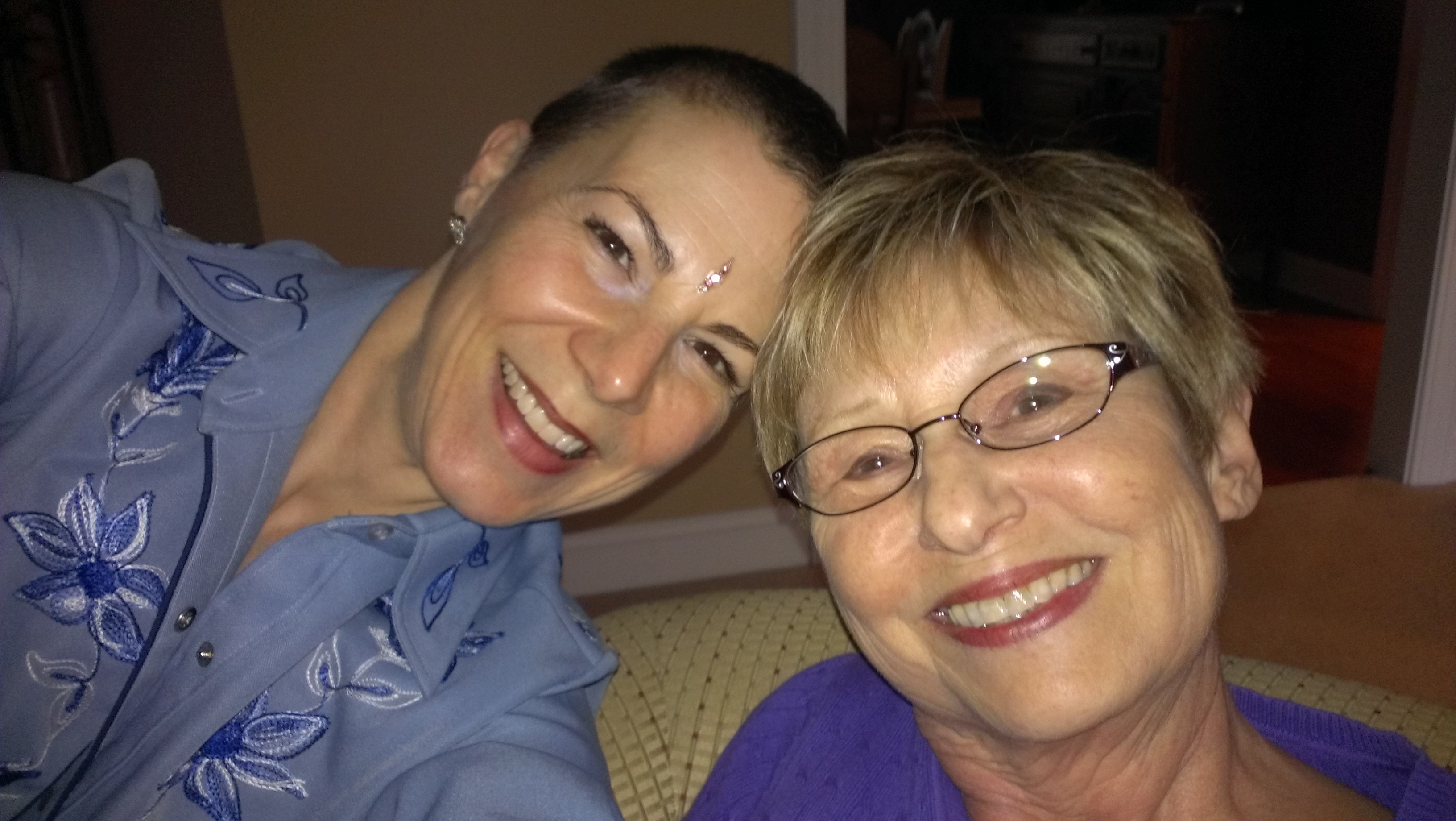
me and momI’m at my mother’s home.  I’ve only been here once before – three or so years ago.

When I pull up I am not sure I am at the right house.  It looks different than I remember, so I call her from the rental car to make certain I am in the right driveway.  That 173 is the correct address.  It is.  And she comes through the garage to greet me.

Inside, the house does not look familiar.  I did not grow up here.  It has been too long since I have visited.

I look around the house.  There is a photograph of my brother and his son.  Another of him with both of his children.  There are photographs of my stepfather’s children and grandchildren.  His mother.  My mother and her brother when they are wee.  A sepia-colored family photograph, taken when my Papa Barney, my great-grandfather, was still alive.

There is nothing of me.

The 43-year-old in me says, “It’s not all about you.”  The 7-year-old says, “Why aren’t there any pictures of me?”  The 7-year-old wins.   And I ask, as casually and with as much detachment as I can muster.

My mother responds without missing a beat.  “All the pictures I have of you have your ex-husband in them.  So we have to take new ones.”

My mother is black and white when it comes to her children.  Anyone who messes with her kids is out.  Period.  Even if she liked them very much, which is the case with my ex-husband.  I remember the first time they met. I woke up the next morning and found them eating leftover birthday cake for breakfast, still in their pajamas.  Thick as thieves.

She takes me into her bedroom and shows me a single photograph of myself, flanked by her and my stepfather.  We are eating ribs and pulled pork.  My mother swore I wouldn’t eat it but I surprised her.  I told her my friend Jerry had turned me on to pork ribs at a BBQ a couple of years prior.  How the little Jew now threw down pork with the best of them.

My mother has cut my ex out of the photograph.  I cannot tell that he was ever there.

Later we look at photographs, as we do every time I visit.  It is my desire, not necessarily hers, and she appeases me.  There are, in fact, photographs of my ex-husband.  Of visits.  Of our wedding.  His hair is dark.  I do not remember him that way.  He has been gray now as long as I can remember. 

The photographs are tucked away in a box, along with my wedding invitation, cards and notes, and her wedding photograph – the one from her first marriage to my father.

There are other photographs, lots of them.  Me as an infant, dressed in red and white checks, sobbing.  At 5, with my jeans rolled up, playing in the surf in Malibu.  At 16, in a black dress with a hood.  We are at a family party.  I think I am punk rock.  My mother is next to me, swathed in winter white, smiling.

My 27 years before meeting my ex, stacked, rubber-banded and tucked into a Ziploc baggie marked “Lesley.” 

I stretch out my arms, point my phone at our faces, and take a photograph of the two of us.  I love doing this. I never know how we will capture ourselves in the moment.  The photograph is always a surprise.  Sometimes we are half a face.  A nose.  Only eyes.

I turn the phone around to look at our picture.  We are framed perfectly.  Centered.


Return to the House Where Love Died

1825 n washtenawI just left the house where love died.  I can’t take credit for that line.  My friend Jonathan came up with it to describe the place where his relationship fell apart.  But I borrow it, because it is apt.

It’s the condominium my ex and I purchased together in 2007 when we moved to Chicago for his residency.  We still own it jointly, but I am not responsible for it in any way.

Our tenants are moving out, and I offered to do the final walk through before the next ones move in.

I never wanted to buy it.  Home ownership was never my dream.  I liked the idea of freedom.  To change neighborhoods.  To upgrade or downsize, as needed.  To leave paint and snow and water heaters to someone other than me.  But Lee thought it was an investment, an opportunity to step into the real estate market, something we couldn’t do in California.  And I went along with it.

When we are no longer under water, we will sell it.  Lee will pay himself back for any financial losses and we will split anything that remains.  I am expecting nothing.

The tenants have already moved out.  They’ve scrubbed it with organic cleaners they make themselves.  It is immaculate.  They are wonderful tenants.  We have been lucky.

I look at the floors.  I forgot how rich the walnut is.  That the kitchen is big enough for two to dance in.  How excited I was to have new appliances, cherry cabinets and granite countertops.  A bathroom with a pedestal sink and good water pressure.

The curtain hooks and rods we left are still up .  As is the full-length mirror in the second bedroom.  The shoerack.  And a piece of fabric I used to cover the master bedroom window that faces a brick wall.  I made a hem using an iron and tape I bought at Poppy Fabric.   I brought it from California.  I loved the pattern.  I forgot it is here.

There is a built-in wine rack next to the dishwasher.  I had big plans for it.  Ironically, I stopped drinking not long after we moved to Chicago.  I kept rolled up cloth napkins and tablecloths in the slots instead.

There are pin size holes in the wall where we hung a spice rack.  A nail drilled into the exposed brick where I hung the Napa Valley Mustard Festival poster.  I bought it my first year in San Francisco, years before I met Lee.

I remember arriving here on a steamy, grey July day.  Putting the keys we received via FedEx in the door and the relief we felt when it opened.  We slept in sleeping bags on the floor until our truck arrived later in the week.

I thought about Passover Seders – sitting on the floor, on pillows – sometimes more than a dozen of us, recounting the story of the Israelites liberation from bondage.  I thought about parties we had, cramming 50 or more of my coffee-swilling comrades into the 800 or so square feet.

I thought about the day we left Chicago for Seattle.  The movers had come.  The condominium was empty.  We stayed the night at my friend Pam’s.  She made us egg and cheese sandwiches for dinner and we watched her daughters perform an interpretive dance to Simon and Garfunkel – the oldest, a little bit flirty with my then-husband.

We came back to get the cats.  To put the pod on the roof, load up the car and go.  The pod didn’t fit.  Lee had to jerry rig it and hope for the best.  When we were packed, I went back inside a final time.

I walked to the back office – the only room where the sun streamed in.  It created a rainbow pattern on the dark, wood floor.  I got down on my knees.

I thanked God for this home.  For my time in Chicago.  For my friends.

I thanked God that I was sober.  For all that I got from this place I didn’t think I wanted to be.  In a home I never wanted to buy.  I knew I had been exactly where I was supposed to be.  And now I was leaving.

I wept.

Nine days prior Lee told me I didn’t have to come to Seattle.  That he had taken me from my home once before.  That he didn’t want to do it again if I wasn’t willing.  But it was too late to turn around.  It was easier to go than to not go.

And so I went.  Because it was easier.  Because, I believed, that’s what married people do.  Because I wasn’t quite done.

I thought I would feel more emotional being at the house.  That I might feel more sadness.  More anger.  Wistful.  But I didn’t.  I watched the memories as I would a current-events film loop in the third grade – the kind that was no longer current by the time it arrived.

Our tenant showed me photos of the home he and his girlfriend just bought, not far away.  The kitchen, the bath – not unlike ours.  The walls he painted – turquoise and slate.  He seemed proud. Hopeful.

He offered to hand over the keys to the next tenants.  I gratefully accepted.

He is done here.  Me too.

Artist’s Date 18: Letting Go One of God’s Creatures At the End of Her Rope

220px-The_Night_of_the_Iguana_posterI’m wearing a short dress and boots because the weather is mild.  It doesn’t occur to me that my seat at The Artistic Home theatre might be vinyl and that my thighs might stick to it during a three-hour production of The Night of the Iguana.

It doesn’t matter.  I am transfixed as pieces of my story fall from the mouths of Tennessee Williams’ characters.

“It’s almost impossible for anybody to believe they’re not loved by someone they believe they love,” Shannon shouts.  I should write down the words, but I don’t.  I suck in quickly through my nose, like I’ve been hit.

I bought my ticket a few weeks ago.  The production has gotten good reviews.  And my friend Ryan is in it.  The same night I purchased a ticket to Oklahoma! at the Lyric Opera Theatre – a future Artist Date.  I was excited.

But now it’s time to actually go and I feel anxious.  This is my first after-dark Artist Date.  The rest were matinees.  Most of them, with the exception of the Joffrey Ballet, naturally lending themselves to a solo outing.  The Art Institute.  The History Museum.  The Lincoln Park Zoo.  A lecture.  Thrifting.  But this is night-time.  Theatre.  Date stuff.

My friend April calls as I am wondering if I am too tired to go.  If the skies are going to open up again, monsoon-style, and I should stay home.  She tells me she has bought a board and is learning to surf.  She’s not waiting for someone to join her.  She says she learned that from me.  From my Artist Dates.

It’s the little nudge I need to get out the door.

There are 49 seats in the theater.  Yes, someone counted – not me.  I see other single ticket holders too.  A woman wearing rain boots with horses on them.  A tall Swede (I have no idea if he actually is, but he looks the part) with long, blonde hair, wearing a messenger bag slung across his body.  A man at the end of my row talking about pizza and where he likes to take first dates – to Spacca Napoli.  At least if the date is a drag, the pizza is good, he explains.

I want to join in the conversation and tell them my old trick of choosing a place where I know the staff.  I remember a small jazz bar in Detroit which served this purpose for me.  Looking back, I wonder if I liked it because it allowed me to play “the big shot.”  Or was it because I felt safe there?  I say nothing.  At the intermission I watch him chat up a tall, blonde in a turquoise tunic.

In my seat, with the lights dimmed, I watch painful, scripted pieces of my life with curious compassion.  They unfold in a different story – with different names, a different place, a different time.  But I know them.  The way I knew my friend Jennifer when I saw her in a hotel lobby for the first time in 30 years.  Not quite as I remembered or imagined, but more than familiar.

Maxine and Fred’s marriage – devoid of physical intimacy, where once-lively conversation has deteriorated to little more than grunting at one another.  Her attempts to force Shannon into Fred’s shoes, his socks, his bedroom – into the role she’d like him to play.

Charlotte’s insistence that Shannon return her love.

Hannah tending to Shannon, sharing the pain – his “spook,” her “blue devil” – and poppy-seed tea, one difficult night.  And, at her urging, cutting free the iguana tied up under the porch – letting go one of God’s creatures at the end of his rope.

I didn’t cut the rope.  But I dropped it.  Finally.

I saw the truth about my relationship with my Southern Svengali –the object of my affections for far longer than most would consider a reasonable shelf life.  We hadn’t spoken in months.  And when we did – just the other night – there wasn’t a whiff of flirtation left between us, from either direction.  Only deep, deep affection and friendship.

I was surprised.  A little bit relieved.  Sort of sad.  The fantasy had fallen away.

The struggle was over.  I could accept the inevitable, what was already written.  Like Shannon walking hand-in-hand with Maxine to swim in the liquid moonlight.  Surrender.

Artist’s Date 17: If You Knew What I Was Reading…a Little Bit Naughty at the Library

I am reading erotica at the Chicago Public Library.

I didn’t plan on it.    

I am here to pick up a Charles Bukowski biography.  Or perhaps Sylvia Plath.  Anne Sexton.  Or Pablo Picasso.

It is one of my weekly assignments in Finding Water, the second in The Artist’s Way trilogy – reading a biography (or autobiography) that details an artist’s life, especially the disappointments and hardships weathered.  It’s an easy and obvious Artist’s Date – number 17. 

But first, I’m going to need a library card. 

It’s about 2 p.m. on Saturday afternoon and it’s busy in here.  I ask the guard what I need to do to get a library card.  She points me to a painted blue desk to fill out a form, and then to the check-out counter, where there is a long line, for processing.

A little girl in front of me is trying to balance a stack of large books she has chosen.  She is about five.  On the wall to my right is a display of staff picks, among them, Committed by Elizabeth Gilbert.  It is the follow up to Eat, Pray, Love.  I make a mental note.  I’ve wanted to read it, but not today.

I am handed a library card, my name printed on it with a Sharpie marker.  The librarian apologizes that there is no clear tape to put over my name so it doesn’t smear.  I lay it flat in my wallet and hope for the best.

The map on the wall guides me to the second floor.  I’ve been here once before – this past fall, to print out boarding passes for my trip to Charleston.  I forgot I could pull them up on my smart phone at the gate. 

It was raining and I was talking on the phone to my father, telling him about my plans to see my birthmother.  I had gotten a call just the day before.  She was dying.  It seems like a lifetime ago.

I point myself to a bank of computers, to locate the biography section.  My search does not pull up the results I am looking for.  I change my search terms.  Nothing.  It is not intuitive.  I miss the card catalog.  The tiny wooden drawers with typed cards sitting in alphabetical order inside.  It was easy.  Hello, Dewey Decimal.

I wander away from the computers to the shelves.  Each end cap lists what is contained in the stacks.  Of course it does.  I wander through the periodicals.  AARPPeopleThe Chicago Jewish Week.  There are bound books, entire years of Time, The Saturday Evening Post and National Geographic dating back to the 1940s.  I make another mental note, to come back to better acquaint myself with publications I plan to pitch.

I keep wandering, reading end caps.  Nope.  Nope.  One of my Weight Watchers members is standing in front of me.  She is wearing purple horn-rimmed glasses.  We exchange hellos and brief small talk.

“American Literature.”  Sounds promising.  I feel silly, like I should know my way around the library.   I remind myself I’ve only been here once before.

I remember feeling intimidated by the library at Michigan State University.  I avoided it, even when class assignments clearly dictated its use.  That is, until I started going there with my friend, Brian. 

He suggested we go to the library to study on the weekends.  And to look at cute boys.  We took cigarette breaks in the men’s bathroom on one of the upper levels, sitting on vinyl couches in the tiled bathroom lounge as if we were at Nordstrom’s.  Smoking.  Guys would come in to pee and look at me funny.   Confused, sometimes blushing.  No one ever said a word.

I am in the A’s of the American Literature section.  The first book I see is The Best American Erotica 2005, edited by Susie Bright.  I love the Best American series.  I have copies of several years of The Best American Food Writing, The Best American Travel Writing and The Best American Essays.  I didn’t know there was a The Best American Erotica.

I pull it from the shelf.  On the cover, a pair of women’s feet strapped into incredibly tall sandals.  The heels look like nails.  Thin.  Silver.  Blue, sheer panties dangle around her ankles.  I carry it with me, smiling to myself.  I hadn’t planned on this.

The section includes both literature and biographies.  I pull titles that speak to me.  Names I do not know.  Women war correspondents.  I put them back.  I think I should write them down so that I can mention them in my blog, but I don’t.  I’m trying to be “in the moment.”

I stumble upon Henry Miller.  There are several biographies.  I think about reading Tropic of Capricorn.  I had tried many times without success.  It “took” the day I approached it hopped up on coffee and cigarettes. 

I felt frenetic, like the writing, stretched out on the couch, reading the minimally punctuated stream-of-consciousness straight through.  I don’t remember much of what I read, but it made sense to me at the time.  I felt like I had cracked the code.

I settle on The Happiest Man Alive by Mary V. Dearborn and tuck it under my arm with the erotica book.  A theme is developing.  I scan for Anais Nin.  No biographies.  No Delta of Venus – my favorite.  Only her journals.

I pick up a biography on Anne Sexton, a black and white photograph of her on the cover.  She is wearing a sleeveless dress with a swirling pattern, and she is holding a cigarette – her hands gesturing.  She has great legs.

I read the inside cover and learn that she was a fashion model.  That she married in her teens.  That she attempted suicide after the birth of her second daughter, and that a therapist suggested she try writing poetry.

She wrote for 18 years, producing nearly a dozen books – including Pulitzer Prize winning Live or Die.  The final words on the inside back jacket read, “It is not a tale for children nor for the innocent, for Sexton’s complicity in her own self-destruction was the despair of her friends, to many of whom this biography will reveal more than they understood while Sexton was alive.”

I add the book to my stack.

The alphabet begins again and I find Bukowski, Philip Roth, Nikki Giovanni, Maya Angelou.  I pick up the Bukowski biography.  It is much thinner than the Miller and Sexton tombs.  Most of his face is covered by a folded newspaper, but he is clearly smiling.  The crow’s feet at his eyes and the parentheses around his mouth give him away.  His hands have age spots.

I am limited to checking out just five books during my first 30 days, so I think it is best to stop.  I sit down at a table by myself and open the erotica book.  I scan the table of contents, looking for a short reading. 

“The Bounty of Summer,” by Carol Queen.  Pages 79-81. 

It is well written, neither violent nor overly sentimental.  It’s about play and surrender, trust and fruit.  Yes, fruit.  She writes, “It’s the honeymoon suite, though we are not married, just fucking like it’s the only thing we will have to do for the rest of our lives.” 

I like it.

I begin another story, “After the Beep,” about a man receiving anonymous, sexual instructions on his answering machine.  It is titillating but too long.  I do not finish it.  I begin another, “Sit.”  Three pages in and it’s all still set up.  Nothing dirty.  I cannot “sit” with it.  I close the book. 

I think about the journals I recently unearthed.  They are filled with poetry and prose.  Juicy, explicit details of my experiences in my 20s, when I was single.  The writing is good.  Better than this, I think.

I gather my books.  Before heading to the check out, I pull a second The Best American Erotica from the shelf – 2006.

The librarian scans the Miller biography.  Bukowski.  Sexton.  They are due back May 4.  I will never read them all by then.  She scans in the two erotica books.  “Figures,” she says.  “They are not in the computer.” 

What does that mean?

“I’m just going to give them to you.”

I giggle to myself.  There’s a dirty joke in there somewhere.  And I walk out with my stack.

Prelude to Artist’s Date 17: I Got Buk Back

Charles Bukowski used to be mine, but I gave him to my ex in the divorce.  Funny thing, my love for Buk drew him to me.  A chick who liked a dirty-old misogynist poet.

I got him back.  He showed up in the middle of week three of Finding Water, the second book in the Artist’s Way trilogy – the week titled “uncovering a sense of support.”

The assignment was to list five deceased artists.  Choose one to ask for help and guidance.  Be still and scribe what I hear.

I chose eight. 

Picasso – my high school Spanish teacher called me this during my pink hair, blue lips phase.  “You look like a Picasso picture.  Except your nose should be over here…” he would say, pointing far to the left, off of my face. 

Marc Chagall – the Jewish artist I imagined might be my biological grandfather but wasn’t. 

Jack Kerouac.  Adrienne Rich.  Sylvia Plath.  My teacher and friend Rabbi Alan Lew. 

Charles Bukowski and Anne Sexton.

I thought for certain I would hear from Sylvia – after all, hers was the name of my alter ego.  My friend Teresa used to do a one-woman show in San Francisco in which she would channel me, smoking, speaking like an old, Jewish woman from Queens…”Men are not magical beings.  They are people.  With penises.  And problems.”  She called me Sylvia.  I never really said those words.  I wasn’t that wise.

But it wasn’t Sylvia who wrote to me.  Nor Anne – who I knew little about except that she too took her own life.  It was Bukowski.  Buk.

I first became acquainted with Buk in college.  My roommate Natalie and I were spending the night in a hallway, in line, trying to secure a coveted room in a popular dorm.  A dorm where we spent so much time that everyone thought we lived there already.  Where my best friend Brian lived, as well as my first lover, Bill, and my first boyfriend, Stu.

We brought pillows and blankets and snacks.  A boom box.  Natalie brought a copy of Bukowski’s Love is a Dog from Hell.  She read to me.  Poems of drunkenness, debauchery and oftentimes a redhead, which I was then.  I was smitten.

My ex owned every Bukowski book published.  He packed them up – along with his stereo, massage table, and a few pieces of clothing when he moved from New England to California.  They soon landed on two entire bookshelves in my San Francisco garden apartment.

I didn’t love Buk the way he did.  I preferred The Days Run Away Like Wild Horses, written for Jane, his first love.  He preferred autobiographical Ham on Rye.  He shared it with me.  Gritty.  Dismal.  Difficult.  Painful.  I could barely make my way through it.

I put aside Buk.  Besides, I had Philip Roth.  Jason introduced me to him a few years prior.  Jason – the horny, Jewish artist who told me he would marry me.  He didn’t.  Every once in a while he pops up on Facebook.  With a single word he tells me everything I need to know.  Usually it’s liver.  Think Portnoy’s Complaint.

So imagine my surprise when Buk’s words came through me, to me – offering up what he knew about being a writer, what he knew about me.

He told me my story had value,that my experience mattered.  He said the life of a writer isn’t always pretty.  Made me promise I wouldn’t let anyone put me in a golden cage, like Tully, the wealthy book publisher, tried to do to him in BarFly. 

“It can happen,” he said.  “Especially to someone like you.  ‘A beautiful subject.’  Just like your friend the photographer said.”

It could be a publisher or an editor.  It could be a lover.  Especially as I don’t so much like to be alone.  He said that I believe more in what others say about me than in what I know about myself.  Dangerous territory.  “Makes you a victim.  Beholden to.  Dependent.”

He told me now is the time for writing.  For growing my backbone.  He wasn’t clear what would be my path to strength, but he was certain it wasn’t jumping into bed with someone.  “Trust me, I know.  Trust me because I love sex as much as you do.  Probably more.”

He continued, “The sex won’t dry up but your mind, your creativity and your opportunities will.  Your shelf life as a writer can and may.  I know it seems like it should be the other way around but it’s not.  Trust me…you won’t dry up.”

He told me to take this year and “do the fucking work.  Take your ex’s money and make something out of it.”  He said to quit worrying about the artists and to “be them.

“Actually, be you.  And keep sharing you and your art with anyone and everyone who will pay attention.

“Oh and I thought you’d like to know…yes, the artists, they see you.  But it doesn’t matter because they ain’t going to get you a book deal”

Then he surprised me, bringing greetings from the others on my list. 

Sylvia says don’t ever stick your head in an oven.  Seriously. And don’t ever be overshadowed by a man.

Rabbi Lew says he loves you, and to keep partnering with G-d.  (Buk didn’t know what it meant, but I did.  Referring to Abraham Joshua Heschel’s Between God and Man, I asked Rabbi Lew, “What’s this partnership with G-d crap?”  He replied, “Lesley, tell me about your father.”  And I burst into tears.)

Picasso says do right by him, your namesake.  Yes, you have been a muse.  But it’s better to be the artist than the muse. 

Chagall says he’s sorry he wasn’t your grandfather.  That he liked your blog about him and your relationship with America Windows.

Kerouac says to read him again, especially as you get ready to go on the road again.  Rich says to remember that you are a poet also.

Then he wished me luck.  Called me kid.  Told me to keep writing.  To believe in what I have to say, because if I don’t, who will? 

He let me know he was “right here…if you need me,” used the word “muse” as a verb and laughed.  “Good one, kid.”  And he signed off,

“XO – Uncle Buk.”